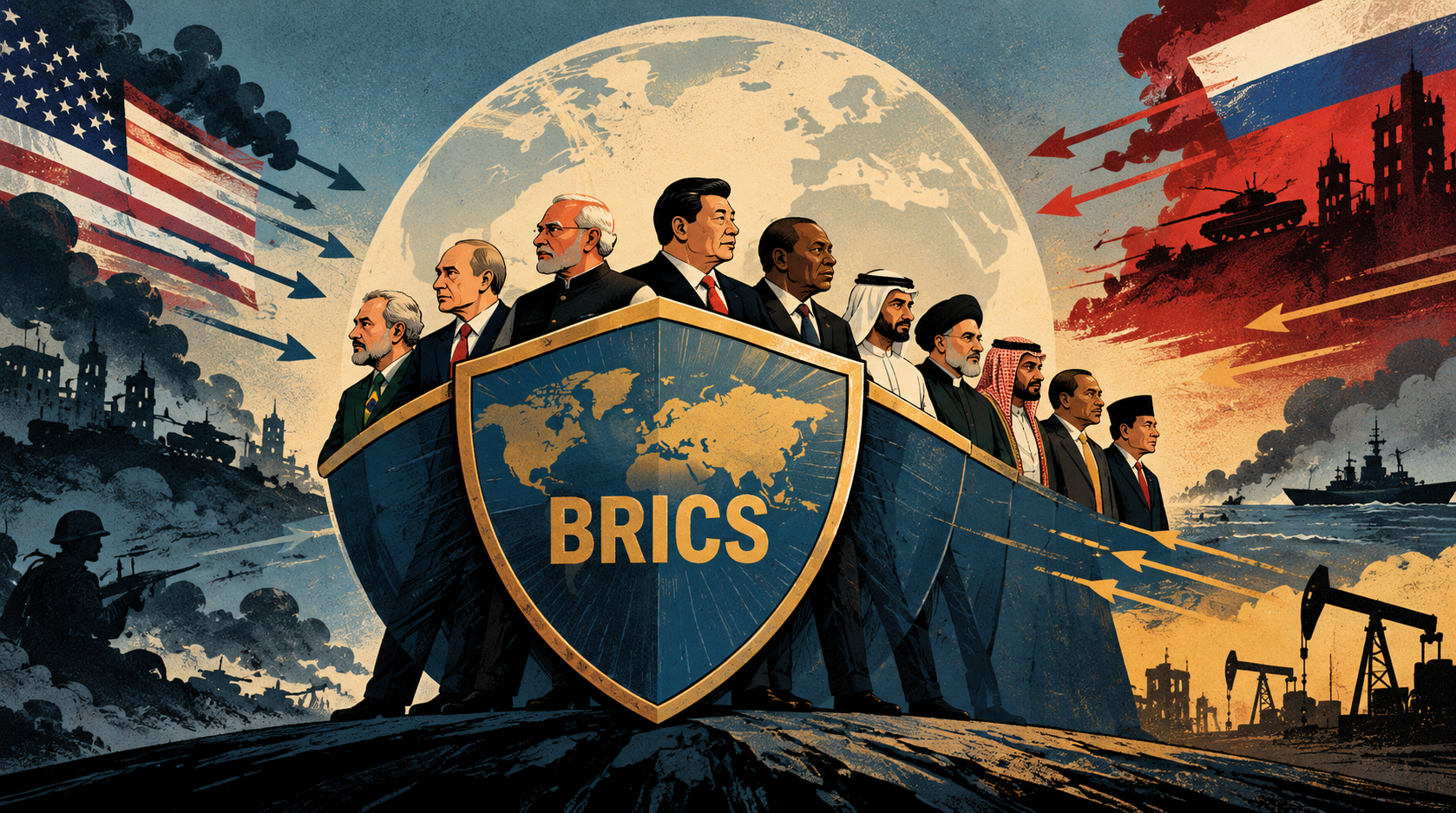
Shield, Not Sword: The Promise and Limits of BRICS
When wars widen, sanctions tighten and rival powers demand support, countries outside the traditional centres of power face a difficult question: how can they protect their interests without being pulled into someone else’s contest? BRICS is one forum through which a number of emerging economies are trying to answer that question. Its value lies less in acting as a united front than in keeping diplomatic and economic options open.
BRICS is a political and economic grouping, not a formal military alliance. It has no collective-defence treaty, standing military command or obligation for one member to fight on behalf of another. Its eleven members—Brazil, Russia, India, China, South Africa, Egypt, Ethiopia, Iran, Saudi Arabia, the United Arab Emirates, and Indonesia—have different interests and foreign policies. The group’s own official description presents it as a forum for political and diplomatic coordination. That distinction matters: BRICS can create space for negotiation and cooperation, but it cannot be assumed to act as one bloc in every crisis.
A platform, not a military shield
The “shield, not sword” metaphor is useful only if it is not taken too literally. BRICS does not protect its members through a common defence guarantee. Instead, it offers regular meetings, political consultation, and opportunities to coordinate positions on issues such as development finance, trade, climate change, and reform of international institutions. At the September 2026 New Delhi Summit, leaders again called for disputes to be handled through dialogue, consultation, and diplomacy, while backing a more representative international system.
This approach can be useful when countries want to resist pressure to take sides. A forum that includes states with different political systems can keep channels open even when they disagree. But declarations are different from conflict resolution. BRICS has no independent authority to impose a ceasefire, compel a member to change policy or guarantee that diplomatic appeals will be followed. Its influence depends on whether members are willing to turn shared language into practical action.
The limits of unity
The group’s internal differences are not a minor complication; they are central to understanding what BRICS can achieve. India and China are both members, yet their relationship has been shaped by a contested border and the deadly 2020 confrontation in eastern Ladakh. India’s Ministry of External Affairs says the two countries reached an agreement on patrolling arrangements in Depsang and Demchok in October 2024, leading to disengagement at the remaining friction points from 2020. That progress shows the value of negotiation, but it does not erase the wider boundary dispute or the strategic competition between the two countries. Their membership of BRICS has not made those differences disappear.
Russia’s war in Ukraine presents another test. Russia is a member, while other BRICS countries have maintained their own relationships with Kyiv, Moscow, Europe, and the United States. They have not adopted a single, binding foreign-policy line on the war. Differences also emerge over conflicts in West Asia, where members’ security ties and regional priorities do not always match. The 2026 New Delhi Declaration calls for restraint, civilian protection, and diplomacy in the region, but its careful wording reflects the need to accommodate different national positions.
Consensus can therefore be both a strength and a weakness. It allows governments to remain in the room without surrendering their separate positions, but it can also produce statements that avoid the sharpest disagreements. BRICS is better understood as a place where competing interests are managed than as a united diplomatic actor. That is a more modest role than a common front against the West, but it is also more credible.
Financial alternatives, not an escape from the dollar
Economic cooperation is where BRICS has tried to build more durable tools. The New Development Bank (NDB), established by BRICS countries, finances infrastructure and sustainable-development projects. It has also developed local-currency programmes. The bank explains that local-currency lending can reduce currency mismatches for some borrowers and that it can fund such loans through local-currency issuance or swap markets. These are practical steps toward diversifying finance, not proof that BRICS has created a separate financial system capable of replacing the dollar.
The distinction matters because “de-dollarisation” is often used as if it describes one coordinated project. In practice, it covers several different ideas: settling a particular trade in national currencies, issuing bonds in local currencies, improving cross-border payment links, and discussing wider financial arrangements. Progress in one area does not mean that all BRICS trade has moved away from the dollar. Currency choice also depends on market liquidity, exchange-rate risk, convertibility, payment infrastructure and the willingness of businesses and banks to use alternatives.
The group’s own decisions show how incremental this process remains. In the 2025 Rio de Janeiro Declaration, leaders welcomed work on financing in local currencies and instructed finance ministers and central-bank governors to continue discussing the BRICS Cross-Border Payments Initiative. The wording describes ongoing work, not a fully operational common currency or a completed alternative to existing payment networks. The NDB’s investor FAQs likewise describe local-currency programmes alongside lending that remains largely in hard currencies.
These measures may give governments and companies more choice, particularly where exchange-rate volatility or sanctions complicate transactions. But they do not remove economic interdependence. Members still trade with countries outside BRICS, rely on global financial markets, and have different exposure to sanctions and currency risks. A more accurate claim is that BRICS is exploring ways to reduce some vulnerabilities—not that it has already insulated its members from external financial pressure.
Why its economic weight matters
BRICS’ influence also comes from the scale of its members. Indian government material published for the 2026 summit says the eleven-member grouping represents roughly 49.5 per cent of the world’s population, 40 per cent of global GDP and 26 per cent of global trade. Such figures are useful indicators of collective weight, but they depend on the year, dataset and method used—especially whether GDP is measured at market exchange rates or purchasing-power parity. They should not be mixed with older estimates or presented without a source.
The members use this weight to call for changes to global governance. The 2026 declaration renews support for reform of the UN Security Council and for a stronger voice for emerging and developing economies in institutions such as the International Monetary Fund and World Bank. The argument is not that these institutions should be discarded, but that their decision-making structures should better reflect today’s economic and political realities. Whether BRICS can achieve that reform is uncertain: existing institutions require agreement from states well beyond the grouping, and BRICS members themselves do not share identical priorities.
A shield with limits
The most persuasive case for BRICS is not that it is a unified counter-alliance or a dependable shield against every crisis. It is that it gives governments another setting in which to negotiate, pursue development finance, discuss payment options and press for changes to institutions they regard as unrepresentative. These functions can matter without producing a common position on every war or dispute.
The limits are just as important. BRICS cannot guarantee security, eliminate the consequences of sanctions, or resolve the conflicts among its members. Its consensus-based approach can preserve dialogue but may also dilute responses when members disagree. Its financial initiatives offer additional routes, not instant independence from the dollar or global markets.
For countries seeking greater room to manoeuvre, that may still be worthwhile. In a divided international system, not every useful institution has to be a military alliance, and not every form of influence requires a common army. BRICS’ contribution will be measured less by the strength of its rhetoric than by whether its members can turn consultation into practical cooperation while acknowledging their differences. It is a platform for widening choices—not a guarantee that those choices will always align.





Amazing read, great 👍🏼
Very informative and a very pleasant piece of work🫶🏻 Loved it! Kudos to you!💯
Very good.. awesome
Very well written.. thanks for the great info..
“An insightful read! A commendable effort to explore both the potential and limitations of BRICS. Keep up the great work! 👏🌍
A very insightful article by Khushi Ahuja, offering a thoughtful perspective on BRICS and its evolving role in shaping global economic and geopolitical relations. A commendable piece of writing.
Wonderfully articulated.
Very well written
Loved it perspective . It changed my mind.
An exceptionally well-articulated piece! The depth of analysis, clarity of argument, and balanced perspective make this such a compelling read. Loved how you explored both the promise and the limitations of BRICS without losing sight of the larger geopolitical realities. Truly impressive work!
Khushi is the best ❤️
Khushi is the best ❤️ it’s incredibly well-researched and insightful. Your dedication and clarity really shines through. So proud of you and excited to see what you do next!
I found this article very helpful for me and for my knowledge..
appreciated content
Wonderful work! It’s encouraging to see the younger generation engaging with international relations and global economic cooperation. Wishing you continued success in your writing journey!
wonderful read!