Can India Preserve Its Strategic Autonomy in the Politics of Oil?
India’s policy on imported crude oil has made energy security inseparable from its foreign policy. With nearly 89% of its crude requirements met through imports, New Delhi must balance affordable supplies against the geopolitical risks of its energy relationships. That policy balancing has become more complicated following Washington’s October 2026 executive order establishing additional tariff measures against major importers of Russian energy, even as their application remains waived.
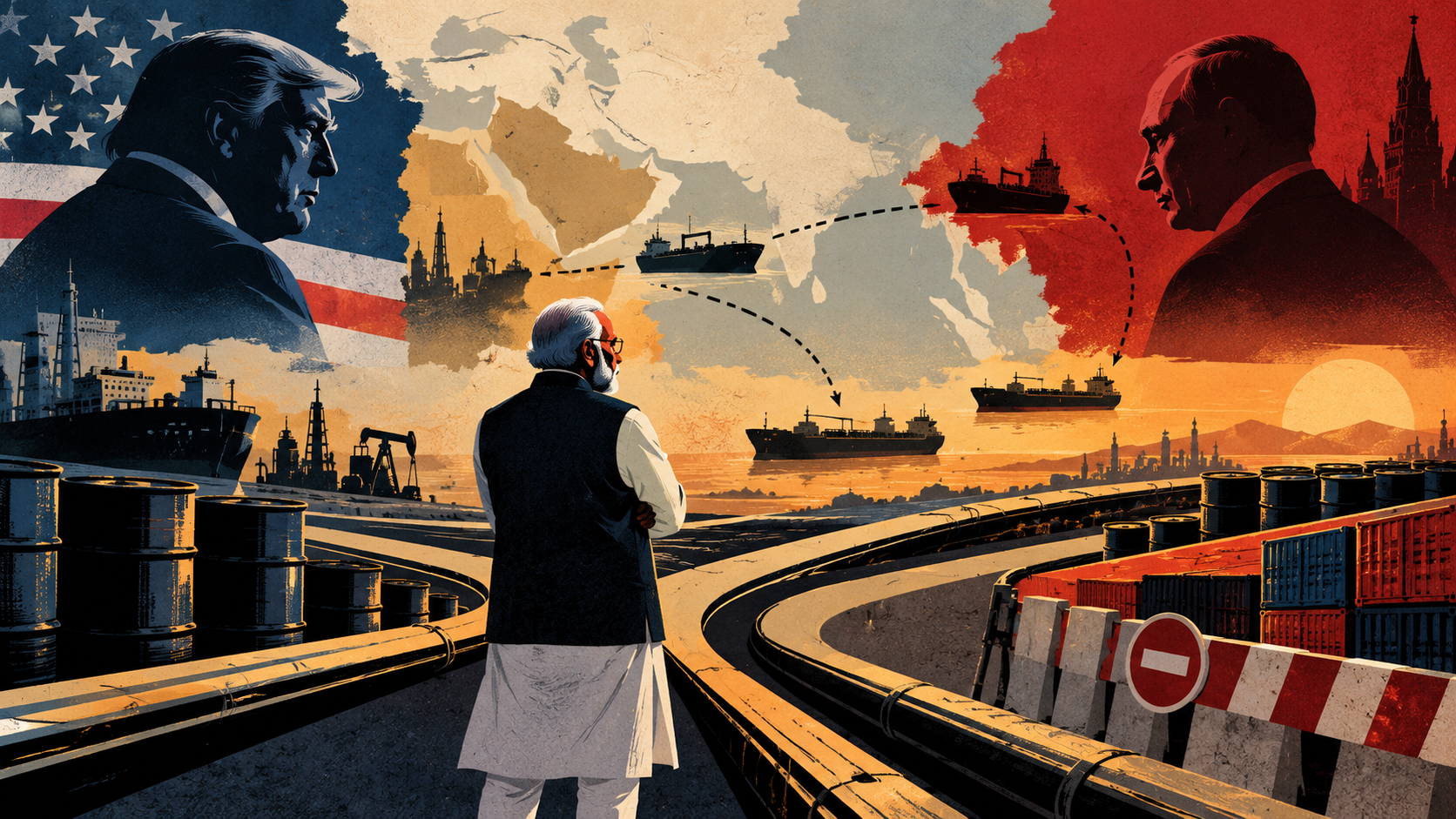
For India, the dilemma is not simply whether to continue purchasing discounted Russian crude or accommodate American pressure. It is whether a country deeply integrated into global energy and trade markets can preserve meaningful freedom of choice when competing economic and strategic interests collide. India’s experience with Iranian sanctions and Russian oil suggests that strategic autonomy depends not only on the willingness to resist external demands, but also on the availability of credible alternatives.
On October 16, 2026, President Donald Trump issued an executive order establishing the tariff framework, while waiving the application of the relevant duties for the time being. The order also leaves US officials monitoring purchases and keeps the possibility of further action open. This is not the same as a tariff being imposed immediately. However, the threat creates uncertainty for countries whose energy choices could affect their trade relations.
For India, the issue goes beyond a single law or supplier. Its experience with Iranian oil before 2019 and Russian oil after 2022 shows how energy sourcing can change as market conditions and international pressure shift. These cases do not mean that India simply follows Washington’s preferences. The picture is more complicated: India makes decisions based on its national interests, but the costs of those decisions and the options available are shaped by the wider international environment. Strategic autonomy, therefore, is not measured only by whether India can reject an external demand. It also depends on whether India has meaningful alternatives when every available option comes at a cost.
India has faced pressure over its oil purchases before. After President Trump withdrew the United States from the Joint Comprehensive Plan of Action, the 2015 nuclear agreement with Iran, Washington reimposed sanctions on Iran’s oil, shipping and banking sectors. In 2018, the US called on countries importing Iranian oil to reduce their purchases to zero, while offering temporary waivers to some buyers.
Iran had been an important oil supplier to India. Indian imports from Iran reached around 620,000 barrels per day at their 2018 peak, but a temporary US waiver capped purchases at about 300,000 barrels per day for a limited period. When Washington chose not to renew the waiver, India stopped importing Iranian crude after April 2019.This episode shows how another government’s decision can narrow the practical choices available to an oil-importing country even when that country has its own reasons for wanting to continue the trade.
The Russian case unfolded differently. Before Russia’s full-scale invasion of Ukraine in February 2022, Russia supplied only about 2.5 per cent of India’s crude oil imports. Western sanctions and the European price cap then reshaped the market for Russian oil, prompting Moscow to offer discounted crude to buyers in Asia. Indian refiners took advantage of the lower prices, and Russian oil went on to become India’s largest source of supply.
By 2023, Russia accounted for over 35 per cent of India’s crude imports, according to S&P Global. By July 2026, its share had climbed to a record 2.8 million barrels per day, or about 55.5 per cent of India’s imports, according to the Centre for Research on Energy and Clean Air. The crucial difference from the Iranian case is the scale of Russia’s role in India’s energy mix. Cutting purchases from a supplier that accounts for such a large share would require refiners to find alternatives, potentially at higher prices or with different shipping and insurance risks.
The two cases are not identical. India stopped buying Iranian oil after a temporary waiver expired within a sanctions regime targeting Iran. The growth in Russian oil purchases, by contrast, was driven partly by discounted prices and the redirection of global trade following Russia’s invasion of Ukraine. Taken together, however, the cases show that India’s energy strategy responds both to commercial incentives and to changes in the political conditions under which oil can be purchased.
India’s decisions on Russian oil must also be understood in the context of its much wider economic relationship with the United States. The US is a major market for Indian goods and services, particularly information technology. According to Reserve Bank of India data released in September, the US accounted for 54.1 per cent of India’s software services exports in 2025-26, worth about $119.7 billion.
Indian professionals and households are also connected to the US through employment, investment and remittances. India received a record $135.4 billion in remittances in 2024-25, and the US was the largest source, accounting for 27.7 per cent of the total in 2023-24. These links do not mean India must align its energy policy with Washington. They do mean, however, that a sharp deterioration in trade relations could have consequences well beyond the oil sector.
Energy decisions rarely come down to a single calculation. Discounted Russian crude helps refiners manage costs, while supplies from other countries may be more expensive or involve different transport risks. At the same time, India has an interest in preserving access to the US market. The challenge is not simply to choose between Russia and the United States. It is to balance affordable energy, reliable supplies, export interests and the diplomatic room needed to make independent decisions.
India has consistently defended its right to make foreign policy decisions in accordance with its own national interests. External Affairs Minister S. Jaishankar has described strategic autonomy as an important part of India’s political outlook and argued that oil companies consider factors such as availability, cost and risk when choosing suppliers. The Ministry of External Affairs has likewise presented diversification in response to market conditions and international developments as central to India’s energy-security strategy.
These statements set out a clear principle, but the practical test of autonomy lies in the choices available when national interests come into conflict. India may consider discounted Russian crude commercially valuable, yet the potential cost of tariffs on its exports could change the calculation. It may look for alternative suppliers, but diversification takes time and does not necessarily deliver the same price, volume or logistical reliability.
Strategic autonomy should not be measured only by whether India refuses external demands. Equally, every adjustment in its oil purchases should not be treated as proof that India has surrendered its independence. A country can make a sovereign decision to diversify suppliers because it wants to reduce risk. It can also choose to continue buying from a particular supplier because the price and availability meet its needs.
The central question is whether India retains meaningful alternatives and can weigh their full costs, rather than being left with only one viable course of action. This is why diversification matters. A wider range of suppliers can reduce dependence on any one country and help India respond to price changes, shipping disruptions and sanctions. Energy security requires more than access to oil; it also requires the ability to manage these risks without allowing any single relationship to dictate the country’s overall policy.
The October 2026 executive order shows why India cannot treat the current position as settled. The waiver may remain in place, or it may be changed. India must therefore assess not only the terms in force today but also the possibility that they could shift.
India’s response is likely to require a combination of measures rather than an abrupt and complete switch to other suppliers. It can continue to assess crude purchases on the basis of price and availability, widen its pool of suppliers, and engage with Washington on trade and energy issues. It can also explain that its purchases are commercial decisions shaped by domestic energy needs. Whether these steps will be sufficient depends on how US policy develops, how the oil market changes and what alternatives refiners are able to secure.
For a country that imports most of its crude oil, strategic autonomy cannot mean complete independence from global markets or geopolitical pressure. It means having enough flexibility to protect energy security, limit dependence on any single supplier and make decisions after carefully weighing national interests. The real test is not whether India can make its own choices in principle, but how much room it retains to make those choices when they involve competing economic and geopolitical costs.