From the Heartland to the Western Hemisphere:
Is Trump’s America Drifting Toward Pan-Civilizational Geopolitics?
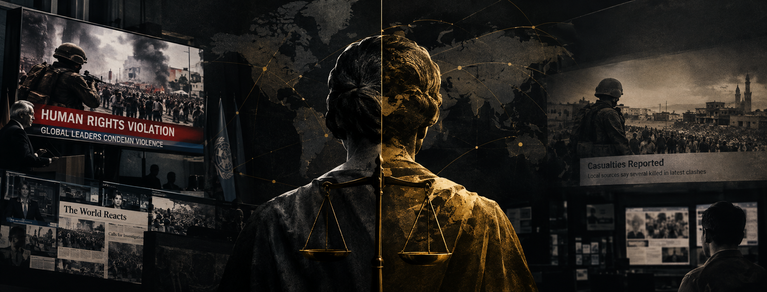
When JD Vance walked onto the stage of the Munich Security Conference in February 2025, most of the room expected a speech about Ukraine, burden-sharing and NATO. What they got was a speech about speech: censorship, migration, annulled elections and “the threat from within.” The instinctive reading was domestic politics exported abroad. I think that is incomplete. Read alongside the rest of the administration’s output, the speech looks like a symptom of a deeper change in how Washington imagines the map: as civilizational blocs, each with its own centre of gravity, rather than a single rules-based order.
This article asks three questions. Is Trump administration’s foreign policy a return to Mackinder’s Heartland? Does Haushofer’s logic of “pan-regions” describe it better? And is the civilizational turn new, or old American exceptionalism in new clothes? The events of 2026 allow firmer answers than were possible a year ago.
Three Theories of Geopolitical Space
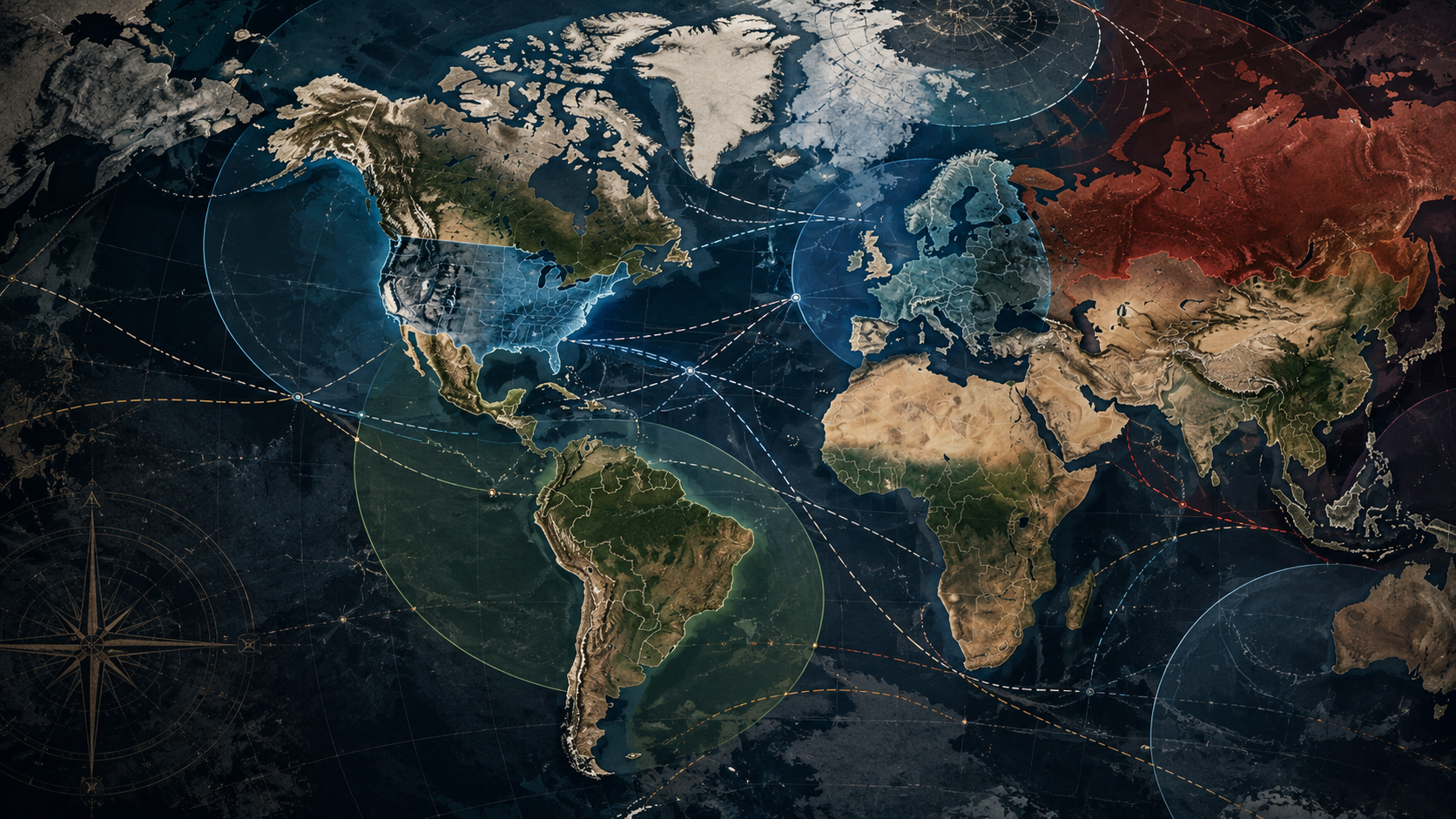
In 1904, 1919 and 1943 Halford Mackinder argued that the interior of Eurasia was the pivot of world history: whoever ruled Eastern Europe commanded the Heartland, and whoever ruled the Heartland commanded the “World-Island.” Karl Haushofer, the German general turned geographer, drew on Ratzel, Kjellén and Mackinder to argue that the future belonged to a handful of continental-scale blocs, each dominated by a leading power: a Pan-America under the United States, a Euro-African bloc under Germany, a Eurasian bloc around Russia and a Pacific sphere under Japan. The model was explicitly borrowed from the Monroe Doctrine. A caution is essential. Nazi propaganda appropriated his ideas, but historians dispute how far he shaped Hitler’s decisions, and the lineage from Geopolitik to the Third Reich should not be overstated. Carl Schmitt gave the idea a legal shape as the Grossraum: a large space dominated by a hegemon from which outside powers are excluded.
In The Clash of Civilizations (1996) Huntington argued that culture and religion, not geography, would drive post-Cold War conflict, with “cleft countries” such as Ukraine caught between civilizations. His prescription was restraint. His “abstention rule” held that core states should refrain from intervening in conflicts inside other civilizations, and he urged the West to renew itself rather than export universal values.
The Heartland problem
The easiest claim, and the weakest, is that Trump is playing Mackinder. Some commentary has read the early Russia outreach that way, as a “reverse Kissinger” meant to pull Moscow from Beijing’s orbit; I treat that as a hypothesis, not an established view, and it does not survive testing. The gambit produced neither a peace deal nor a realignment, and no strategy to deny the Eurasian landmass to anyone. The Heartland is something the United States has historically tried to prevent anyone from owning, not something it manages through summitry.
Nicholas Spykman’s Rimland, the coastal belt of Eurasia from Western Europe through the Middle East to South and East Asia, fits better. Spykman held that whoever controls the Rimland controls Eurasia, and the administration’s concerns map onto it: the Strait of Hormuz and Bab el-Mandeb, the Indo-Pacific military build-up, Europe itself as rimland territory. But the administration’s most vivid moves are in the Western Hemisphere.
From the Monroe Doctrine to Hemispheric Power
The December 2025 National Security Strategy declared that the United States would “reassert and enforce” the Monroe Doctrine, labelled the move a “Trump Corollary” and made the Western Hemisphere the first priority of American power. The label deserves its genealogy. In December 1904 Theodore Roosevelt added a corollary of his own, claiming a US right to exercise an “international police power” in the hemisphere when states there proved chronically unstable, and the Dominican Republic was soon under American customs receivership. Roosevelt’s corollary aimed to pre-empt European intervention. The Trump version aims at China, narcotics and migration.
On 3 January 2026, US Special Forces seized Nicolás Maduro and his wife in Caracas and flew them to New York to face narco-terrorism charges. Rubio later cited the raid in Munich as proof that international institutions had failed and American force had succeeded. Greenland and Panama belong in this section, not under the Rimland. Greenland is geographically North American, and both are classic assets of Alfred Mahan’s sea-power logic: bases, canals and chokepoints that decide control of the oceans. Together with Maduro, they describe a Pan-America in all but name.
The Greenland episode also showed the limits of the administration’s approach. In January, Trump threatened rising tariffs on eight European countries that opposed his push for the island, and then dropped them on 21 January after meeting NATO’s Mark Rutte at Davos, citing a “framework of a future deal” on Greenland and the Arctic. He also ruled out force, though the framework’s content remained unclear. The Munich Security Conference’s own debrief shows how Europeans read the shift: an order whose principles may be “closer to Yalta than to Helsinki,” shaped by great-power prerogatives rather than self-determination. Zelensky’s remark in the same volume, that the United States needs Europe as a market but he was unsure of it as an ally, is the Haushoferian question in miniature: is Europe a partner or a neighbouring sphere of influence?
The parallel has limits. Haushofer imagined cooperating continental blocs, including a Eurasian axis excluding the Anglo-American powers. Trump administration keeps formal alliances alive and has no interest in a Eurasia organised without it. It has adopted the logic of spheres without the grand design.
Civilization Above Institutions
Strip away Vance’s specific complaints, about a Romanian election, British buffer zones and German “firewalls,” and what remains is a claim about identity. Europe’s problem, he argued, was not Russia or China but a retreat from “values shared with the United States.” He closed by invoking John Paul II and a “shared civilization.” Giorgia Meloni, at CPAC days later, defined the West as a civilization born of Greek philosophy, Roman law and Christian values and called the conservative cause “not just an American battle, it is a Western battle.” The 2025 NSS then warned of “civilizational erasure” in Europe and said Washington wanted Europe to “remain European.”
A year later Rubio gave the same register a gentler voice. “We are part of one civilization, Western civilization,” he told the 2026 conference, and he spoke of “forces of civilizational erasure” menacing both sides of the Atlantic. Vance had accused; Rubio reassured. “Our home may be in the Western Hemisphere,” he said, “but we will always be a child of Europe.” Yet the content was continuous. He called uncontrolled migration a threat to the “survival of our civilization itself” and said Washington was prepared, “if necessary,” to renew the West alone.
Three features make this a distinctive version of the idea.
First, the approach is interventionist rather than abstentionist. Huntington’s abstention rule told core states to stay out of other civilizations’ quarrels. The Vance-Meloni-Rubio line does the opposite inside the West. Vance’s meeting with the AfD leader was widely criticised as interference in a German election campaign, and Maduro’s capture shows that the interventionism is not only rhetorical. This is closer to Haushofer’s hegemon-and-dependent model: the lead power sets cultural and political terms for its sphere.
Second, it places cultural identity above institutions. The post-1945 order rested on treaties and shared institutions. Rubio argued the UN had “no answers” on Gaza, Ukraine, Iran and Venezuela, and urged that global institutions be “reformed” and “rebuilt.”
Third, it is contested from within the same Western vocabulary. Pistorius, Scholz and Merz answered Vance not by rejecting the language of Western values but by claiming it: democracy that defends itself against extremists, free speech bounded by independent courts. The MSC debrief notes that both sides say the other has deviated from the community’s normative core. The West has not stopped being a civilizational concept. It has become a contested one.
The contradiction at the heart of the administration’s approach
A coherent civilizational strategy would mean Western solidarity against Russia, China and the Global South. The picture is inconsistent. The administration that speaks of kinship with Europe pursued Ukrainian minerals on transactional terms, threatened tariffs on allies over Greenland, and describes its own approach as “America First” and “flexible realism.” Rubio’s Munich answer on China was pure realism: not talking to Beijing would be “geopolitical malpractice,” and national interests will often diverge. Meanwhile Wang Yi, speaking after Vance in 2025, presented China as a steadfast force in an equal, multipolar world.
The synthesis is a hybrid: a Haushoferian spatial logic (hemispheric priority, spheres of influence, great-power bargaining) wrapped in a Huntingtonian cultural rhetoric and powered by a transactional impulse that belongs to neither. The incoherence is informative: the administration has discovered the power of civilizational language but not translated it into a consistent grand strategy.
Is this actually new?
Only partly, and Warsaw shows why. In July 2017 Trump told a Polish crowd that “the fundamental question of our time is whether the West has the will to survive,” praised “the bonds of history, culture, and memory,” invoked “We want God,” and called on citizens to “fight like the Poles: for family, for freedom, for country, and for God.” The civilizational register is not a 2025 invention. What differs is its object. In Warsaw the threats were external (“radical Islamic terrorism,” Russian destabilisation) and the allies were exemplars: Poland was held up as a model, NATO’s Article 5 reaffirmed, and the alliance praised as a community of “free, sovereign, and independent nations.” Warsaw did warn of forces from “inside or out” and of bureaucratic creep, but it named no allied government as the problem. By 2025 the NSS and Vance had made Europe’s own governments and political culture the problem, with Washington as corrective.
American foreign policy has always mixed hemispheric self-interest (Monroe, Roosevelt), civilizational self-image (Manifest Destiny, Cold War “Western civilization”) and universalism (Wilson, the liberal order). What is new is the ordering. For seventy years universalist and institutional language dominated; today the civilizational register is foreground and institutions are treated as an obstacle.
What we have learned, and what remains open
First, the hemispheric priority is real and backed by force: Maduro’s capture turned the Trump Corollary from a paragraph into a precedent. Second, pressure on allies is bargained and reversible. The Greenland tariffs lasted days, force was ruled out, and the transactional impulse overrode the civilizational one. Third, the rhetoric is calibrated to its audience. Rubio kept the frame but swapped accusation for invitation, and European states answered in the same vocabulary. Europe’s response, from Zelensky’s call for “Armed Forces of Europe” to strategic-autonomy drives in Paris and Berlin, points toward a Pan-Europe that exists alongside American leadership and sometimes against it. What the Greenland “framework” actually contains, and whether pressure resumes. Whether a Ukraine settlement that Europe is asked to underwrite emerges: Rubio said the issues had been narrowed to the hardest ones. What follows Maduro in Venezuela, and whether it reads as a durable hemispheric order or a one-off (The USA is yet to firmly take advantage of the wave of pro-American populist governments in South America). And whether the cultural alliance with sympathetic European governments becomes policy or stays rhetoric. If the answers lean toward sustained coercion and concrete political alignment, we are watching a doctrinal shift with profound changes in the West. If not, we are watching something older: a great power discovering that the language of civilization is a cheap way to renegotiate the terms of its alliances.