Satluj: The River That Refused to Forget
A film about the man who counted Punjab’s secret dead was itself made to disappear. What the removal of Satluj reveals about how democracies handle an unusable past.
Rivers possess an inconvenient habit. They remember what civilizations insist on forgetting. They carry mountain silt for thousands of miles, preserving the geology of places they have already left behind. Human societies are less faithful. They rename, redact, commemorate selectively, and occasionally mistake silence for healing. The Sutlej has watched empires arrive, kingdoms dissolve, borders split, and republics proclaim themselves eternal. It has also watched bodies disappear.
Punjab, the Sikh-majority border state in India’s northwest, has a modern history that is not a chapter so much as a pressure system. Between the 1980s and the mid-1990s, it was consumed by militancy and counterinsurgency, and human-rights groups have documented a landscape of arbitrary detention, extrajudicial killings, enforced disappearances, and illegal cremations. Human Rights Watch has described the period as one in which thousands of Sikhs were subjected to these abuses, with crematoria records used to conceal deaths and erase evidence. In early 1995, human-rights activists Jaswant Singh Khalra and Jaspal Singh Dhillon used government crematoria records to document more than 6,000 secret cremations by police in one of the Punjab’s districts.
Khalra’s story endures because it is so unsentimental. He was not a prophet wrapped in symbolism or a revolutionary born for posterity. He was a bank employee from Amritsar who discovered that the state’s most efficient form of violence was often bureaucratic. A body could be killed once, then killed again through paperwork. A name could be removed from one ledger and never enter another. He followed the records, and the records led him into the moral basement of the republic. For that, he was abducted and murdered in 1995; Human Rights Watch says it took 10 years before six Punjab police officers were convicted for their roles in the case.
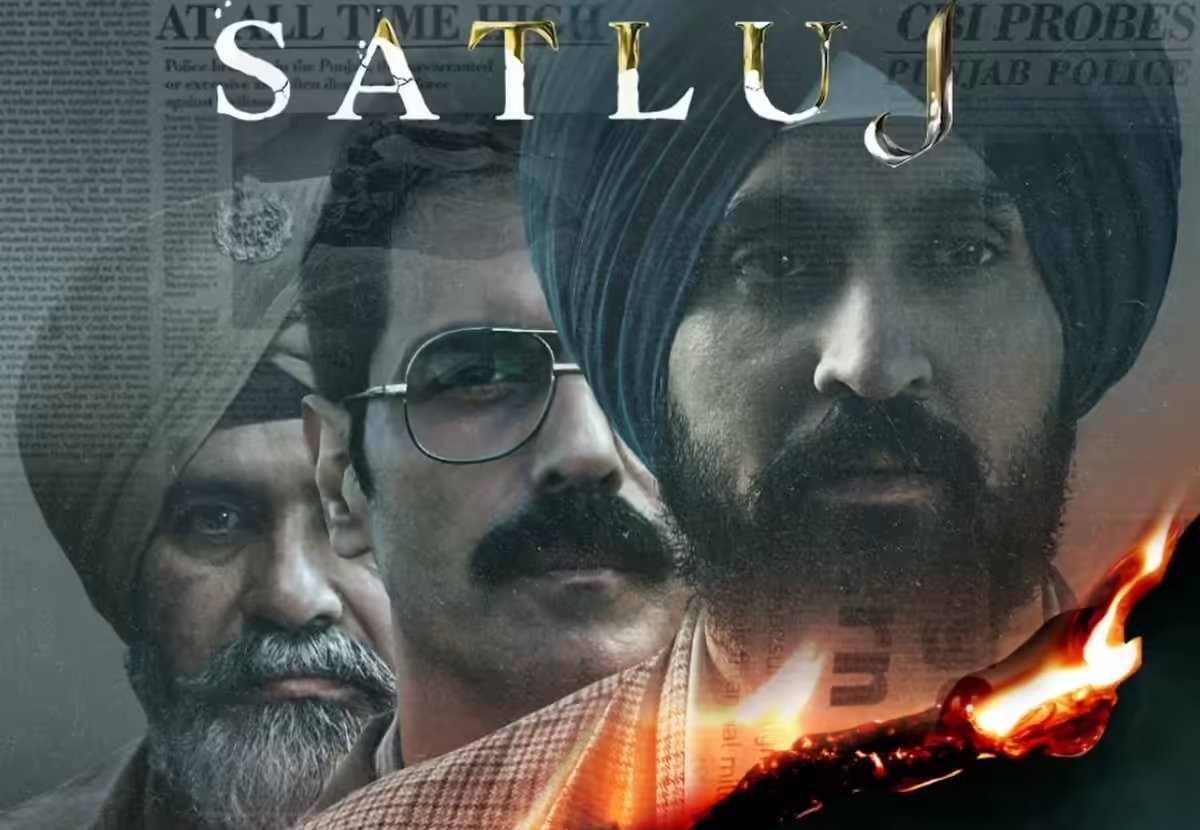
That is why Satluj matters. The film, originally titled Punjab ’95 and earlier Ghallughara, is not merely a biopic of Khalra; it is a cinematic attempt to descend into a history that remains politically radioactive because it is morally legible. It is directed by Honey Trehan and stars Diljit Dosanjh as Khalra, alongside Arjun Rampal, Kanwaljit Singh, Suvinder Vicky, and Geetika Vidya Ohlyan. It reached ZEE5 in India on July 3, 2026, only to be removed two days later; within days it had vanished from the platform worldwide. The government subsequently constituted an inter-departmental committee to examine the film under India’s information-technology framework. Reports said the committee raised concerns about national security, sovereignty and the film’s possible political use. A petition seeking its restoration was dismissed as withdrawn in the Punjab and Haryana High Court. In Punjab, audiences responded by downloading the film and screening it on LED screens in village squares.
The most revealing thing about the film’s disappearance is that it echoes the violence it depicts without reproducing its scale. The film’s removal created an unsettling parallel with the violence it depicts: a story about disappearance was itself made temporarily inaccessible. A story about disappearance was itself made to disappear, first at home and then everywhere. A drama about the fragile witness was turned into a witness of fragility. The platform said the film would be unavailable in India “until further notice,” and reporting attributed the takedown to government concerns and “security” sensitivities. In other words, the old argument has merely changed costume: history is dangerous because it is still alive.
But the deeper truth is larger than any one takedown. Every nation possesses a usable past and an unusable past. Patriotism is often built upon the first. Democracy is measured by whether it can confront the second. The usable past is clean, ceremonial, and exportable. It fits in schoolbooks and campaign speeches. The unusable past is messier. It contains the names of the disappeared, the arithmetic of official abuse, the moral embarrassment of institutions that asked to be trusted after they had already betrayed trust. Punjab’s past belongs to that second category, which is precisely why it keeps returning in forms that power cannot fully domesticate.
This is where the film becomes more than a film. It becomes a test of whether a democracy has enough confidence to permit its own reflection. Mature democracies are not those that have no shame. They are those that have learned shame is not the same thing as weakness. India, like every large republic, contains histories of injury that are easier to soften than to face. Yet history has a terrible appetite for the unsaid. It moves through family memory, regional politics, public argument, and the stubborn afterlife of grief. It refuses to remain where official discomfort tries to place it.
There is, too, a more elemental reason Satluj resonates. Rivers do not ask permission from governments. They do not respect press releases or certification disputes. They cut through terrain by gravity, not by consensus. Memory behaves similarly. Committees can demand cuts. Platforms can erase thumbnails. Governments can pressure, delay, rename, and restrict. None of these acts alters the current. None of them changes the fact that the Sutlej has carried Punjab’s sediment for centuries and will continue to do so long after today’s arguments have cooled into tomorrow’s footnote.
And this is why the censorship of Satluj is not the most interesting thing about it. The more revealing fact is that Punjab’s history still has the power to unsettle official India. That is not a sign that the film has failed. It is a sign that the wound remains open enough to hurt. Khalra counted the dead because the state had made forgetting into a system. Trehan’s film insists that the system can still be named, that the dead can still be counted, and that a republic is not diminished by seeing what once happened in its name. It is diminished only when it insists on looking away.
Governments can remove films. Platforms can erase thumbnails. Committees can demand cuts. None of these acts alters the river. Memory, like water, obeys gravity rather than authority. It bends. It disappears beneath the surface. It changes names. But sooner or later, it emerges downstream, carrying with it every grain of history that power believed had already settled. Democracies are not judged by how successfully they dam that current. They are judged by whether they possess the courage to step into it.