Editorial: Who Decides When America Goes to War?
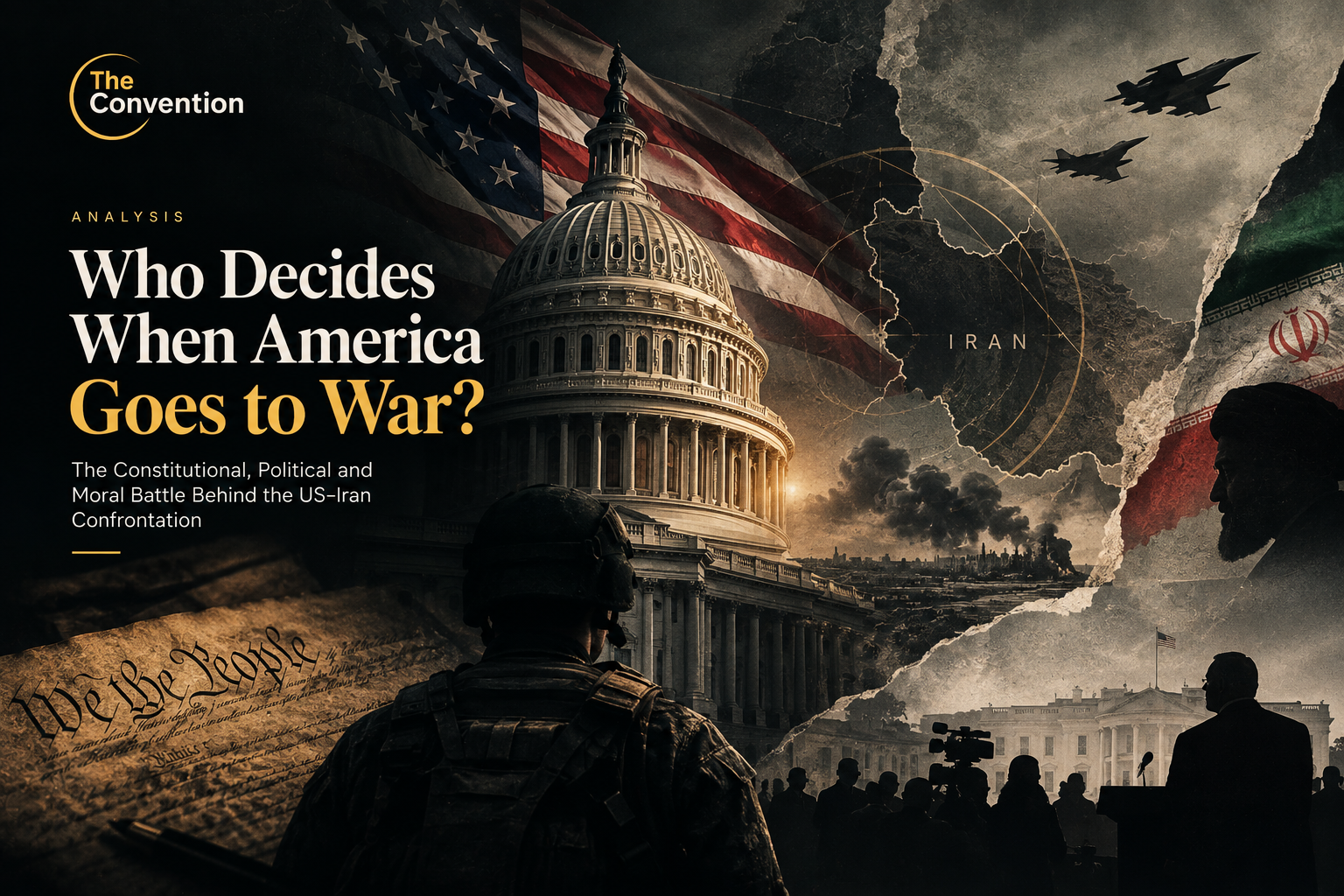
When the United States enters a conflict, the question is never only tactical. It is also constitutional, political and moral. The confrontation with Iran has once again raised a familiar but unresolved problem: who gets to decide when the United States is at war, how far military action can go, and when a conflict should end?
The issue is not confined to Congress and the White House. It affects the public, the military, the media, and the credibility of American foreign policy. For all the talk of strategic necessity, there is a real question about whether US war-making is being driven by presidential impulse, political calculation or a coherent national strategy. In a system designed to diffuse decision-making, the modern reality often looks very different.
The constitutional framework is clear in principle, if less so in practice. Congress has the power to declare war, appropriate funds and regulate the armed forces. The president is commander in chief. Yet across successive administrations, the White House has repeatedly relied on military force without a formal declaration of war, often justifying action under the language of self-defence, deterrence, coalition operations or urgent national security. This has created an enduring problem: the United States can act quickly, but it is less able to explain or limit its actions once the military machine is in motion.
That tension matters because war is not a single event. It is a process. It begins with escalatory language, moves through intelligence assessments and military planning, and is then sustained through operational choices, legal justifications and public narratives. Once military action begins, political actors often find it harder to reverse course without appearing weak, indecisive or manipulated by the adversary. The result is a dangerous drift: force is expanded and then rationalised after the fact.
This is why the Iran crisis has been more than a regional security problem. It has exposed a deeper structural question in American politics: whether the executive branch can still shape policy without sufficient democratic constraint. The presidency has become more dominant in foreign policy, especially in moments of crisis, while Congress has often accepted a diminished role. The consequences are not simply procedural. They are strategic.
The United States has long relied on a model in which presidential authority expands in times of crisis but is rarely effectively reined in thereafter. This is often defended as a matter of speed and operational competence. Yet speed is not the same as prudence. And when military actions are justified by broad claims about deterrence or national security, they can begin to exceed the public’s understanding of what the war is for.
The Iran confrontation is a useful reminder of this. At the start of a crisis, the issue is often framed in narrow terms: protect personnel, deter attacks, secure strategic routes, reassure partners. Over time, however, the objectives become more elastic. One military action leads to another. Diplomatic options become harder to pursue because the political system has already invested in escalation. The result can be a policy that is more about preserving momentum than achieving a rational end-state.
There is a second dimension to this problem: the language of emergency. In times of war, governments often speak as if all decisions are forced by external events. But many of the choices that matter most are political. They concern the scale of force, the duration of operations, the legal authority for escalation, and the level of risk the public is asked to accept. Those decisions are not made by the battlefield alone. They are made by leaders who have to decide how much punishment they are willing to absorb and how much damage they are willing to impose.
The real issue is not whether the United States has the legal authority to respond to threats. It has. The question is whether it has a clear political framework for doing so. Without that, military action can become a substitute for strategy. It can become a way of avoiding the harder work of explaining priorities, setting limits and accepting negotiation.
This does not mean Congress should become a veto-wielding body on every military decision. It does mean that Congress, the public and the executive must be honest about what is being authorised and what is at stake. If the goal is deterrence, then deterrence must be defined in operational and political terms. If the goal is de-escalation, then that must be stated openly and pursued without theatrical posturing. If the goal is broader strategic leverage, then the public should be told how that leverage is expected to work and what costs it will impose.
The challenge is exacerbated by the way contemporary politics rewards performance over judgement. Leaders do not merely aim to protect the public; they also aim to project strength, decisiveness and command. In a highly competitive political environment, a president may find that restraint is interpreted as weakness, while escalatory rhetoric appears to confer political advantage. That creates an incentive structure that rewards danger rather than deliberation.
This is why the war powers debate in the United States is not an arcane legal argument. It is about democratic accountability. The public is entitled to know what the country is fighting for, why military action is being used, whether there are clear limits, and whether there is a political path out of escalation. Without that, the United States risks treating war as a mode of political branding rather than a grave instrument of statecraft.
There is no easy solution. Constitutional reform would be difficult, and political incentives are rarely aligned with restraint. But there must be a more disciplined practice of political debate around military action. That requires clearer reporting, stronger congressional oversight and a higher threshold for escalating into open hostilities. It also requires political leaders to stop confusing the appearance of strength with strategic success.
In the case of Iran, the danger is not only immediate escalation. It is the long-term erosion of the political culture that should govern war. If the United States makes decisions in the language of urgency but without a credible plan for political accountability, then war will continue to be used as a substitute for strategy, and the executive branch will keep accumulating power without the public understanding the cost.
The question remains: who decides when America goes to war? In practice, the answer is often too broad, too diffuse and too dependent on political circumstances. That is not a stable constitutional arrangement. It is a system that works only as long as the costs remain manageable, the goals remain unclear and the public remains willing to accept ambiguity. That is not a discipline, but a risk.