WHAT IS ENGAGEMENT WITH THE TALIBAN FOR?
When the UN’s political chief, Rosemary DiCarlo, met the Taliban’s spokesman in Kandahar on 5 October, her post about the meeting listed the Doha process, socioeconomic pressures, climate change and Afghan returns. Counter-narcotics, alternative livelihoods and women’s and girls’ rights followed last. A day earlier, her post on the meeting with the foreign minister had named international expectations on human rights, particularly for women and girls. The UN’s note on the visit says she conveyed member states’ concerns about women and girls, particularly restrictions on girls’ access to education, and raised the restrictions on Afghan women who work for the UN. It says both sides reaffirmed continued engagement. Neither public account identifies a concrete concession on women’s rights or a timetable for reversing the restrictions. That leaves the effectiveness of the engagement difficult to assess.
Between 12 and 14 October, the EU’s special envoy, Thomas Frellesen, visited Kabul. The EU’s release says he reiterated the EU’s “strong concerns” about the restrictions on women and girls. It, too, records no outcome.
The scale of what is being raised is not in doubt. UN Women counts more than 100 decrees targeting women and girls since 2021. UNESCO estimates that 2.4 million girls remain excluded from secondary education. On 27 October, weeks after those two visits, the Secretary-General told the Security Council that women and girls face “intensifying restrictions on their rights”, citing Afghanistan among his examples (report). Five years in, the question is no longer whether to raise these facts. It is what raising them achieves.
ENGAGEMENT AS SETTLED PRACTICE
Whether to engage is no longer in dispute. Russia has gone furthest. In July 2025 its foreign ministry accepted copies of a new Taliban ambassador’s credentials and said that “official recognition” of the Taliban’s government would boost bilateral cooperation. India announced it would upgrade its Kabul mission to an embassy that October, although, according to Kyodo News, only Russia has recognised the Taliban. The UN and the EU both back the UN-led Doha process: DiCarlo’s visit focused on advancing it, and the EU envoy reiterated the EU’s support for it, according to the EU’s release.
What none of these actors has settled is what the engagement is for. The UN’s note named the results it wants: progress in the Doha process’s working groups on counter-narcotics and the private sector, and “practical results for the Afghan people”. Women’s and girls’ rights appear as concerns conveyed, not as a result sought. The EU’s release lists security, poppy cultivation, the return of Afghans from Iran and Pakistan and climate alongside women’s rights. Each aim is legitimate. Together they describe an engagement with a long agenda and no stated order of priority.
WHAT KABUL IS SEEKING
The Taliban have said publicly what they want. In an interview with The New York Times in August, Foreign Minister Amir Khan Muttaqi said the United States could “reopen its embassy, maintain a diplomatic presence and invest” in Afghanistan’s mines, dams and roads. Later that month he told Kyodo News that Kabul seeks to normalise relations with Washington and that formal recognition is a matter for a later stage. Asked by the Times whether the crackdown on women and girls is a major obstacle to international recognition, he brushed the question aside. He gave Kyodo no timeline for reopening secondary schools and universities to girls.
Normalisation is the currency of this diplomacy: the meetings, upgrades and delegations through which others treat the Taliban as a government. Repeated high-level engagement without publicly identifiable conditions risks providing diplomatic legitimacy without demonstrating corresponding improvements in rights. States may have sound reasons to pay it. Muttaqi confirmed to the Times that Afghanistan is negotiating migration agreements with European countries, and the EU envoy’s visit also covered terrorist groups and returns from Iran and Pakistan. These are real interests. But a government that spends this leverage on migration or counterterrorism should say so, and say what it bought.
WHAT THE STATEMENTS SAY
The statements are not silent on the connection. The EU’s release calls the restrictions on women and girls “a key impediment to the normalisation of relations” and says that Afghanistan’s reintegration into the international community “requires Afghanistan to meet its international obligations”. Resolution 2822 tasks the UN Mission in Afghanistan with promoting compliance with those obligations “as a basis for its full reintegration”. In August the mission itself said that the authorities “must remove restrictions on women and girls”, which it described as a major obstacle to expanding international engagement.
None of these texts says what follows if the restrictions remain, or by when. This was not always so. At the third Doha meeting in 2024, DiCarlo said that the independent assessment behind the process called for “clear conditions and expectations for all sides” and a step-for-step approach. The 2026 statements keep the link and name no steps. Neither Russia’s statement nor India’s, moreover, mentions women’s rights, and these were the two moves that most raised the Taliban’s standing.
WHAT SHOULD CHANGE
Three steps would make engagement something that can be judged. The first is to use the benchmark that the Council has already named. Resolution 2822 urges full access for Afghan women working for the UN to UN premises across the country. The demand is specific, checkable and within the Taliban’s power to grant at once, and DiCarlo raised it during her October visit. The ban has been in place since 7 September 2025, and on 6 September the Secretary-General called again for it to be reversed. Engagement that continues while the restriction stands should say what was asked in return and what was promised.
The second is to seat Afghan women in the formal Doha sessions, not in side meetings. At the third Doha meeting in 2024, DiCarlo said that, regrettably, the Taliban would not sit across the table from Afghan civil society in that format, and civil society was offered a separate session the next day. She acknowledged that some of those invited had declined to attend. The resolution asks the UN Mission to engage Afghan women’s organisations and to promote women’s full, equal, meaningful and safe participation. Any further envoy-level meeting should not repeat that arrangement. The risk is real, because the Taliban may refuse to attend. But accepting a format the Taliban will not share with Afghan civil society is a decision about whose voices count, and it should be made openly.
The third is to use the UNAMA strategic review to publish what engagement has produced. The resolution asks the Secretary-General for a written report on the review by 31 March 2027, to support effective implementation, structural coherence, less duplication and stronger coordination. Its text does not mention outcomes for women’s rights, so the request has to be made explicitly. The Secretary-General already reports to the Council every three months on the situation in Afghanistan and the implementation of the mandate, which includes monitoring and reporting on the rights of women and children, so the material exists. The review should state plainly what years of visits, working groups and diplomatic upgrades have changed for Afghan women, and by what measure.
MAKING THE RECORD PUBLIC
If engagement has produced gains on security or counter-narcotics, that should be said. If it has produced nothing for women’s rights, that is itself a finding, and it belongs in public.
There is one place where a consequence exists. On 5 October, the day DiCarlo met the Taliban in Kandahar, the International Criminal Court unsealed four arrest warrants issued in 2025 in the Afghanistan situation, for gender persecution. They cover the Taliban’s supreme leader, Haibatullah Akhundzada, and its chief justice, Abdul Hakim Haqqani (warrants issued on 8 July 2025), and the ministers responsible for education and higher education, Habibullah Agha and Neda Mohammad Nadim (9 September 2025). The Taliban answered that they have “no form of cooperation or engagement” with the court (Lowy Interpreter). Because the warrants come from a court rather than from the governments conducting diplomacy, they show what attaching a consequence looks like. In the statements cited here, the governments and agencies that profess concern name no data and no price, and the two moves that most raised the Taliban’s standing did not mention women at all. This is how selectivity works in practice: it rarely looks like opposition, and more often looks like a sentence at the end of a list.
Engagement with the Taliban may be necessary. Recognition and diplomatic normalisation, however, should not be treated as unavoidable consequences of continued dialogue. Governments and international institutions must distinguish between maintaining channels of communication and granting political legitimacy. If women’s rights remain central to their stated objectives, they should identify measurable benchmarks, publish the outcomes of negotiations and explain what follows when those benchmarks are not met. Otherwise, diplomacy risks becoming a process measured by the number of meetings held rather than the changes those meetings achieve.
(The opinion expressed in this article belong only to the author and do not necessarily reflect the views of The Convention).
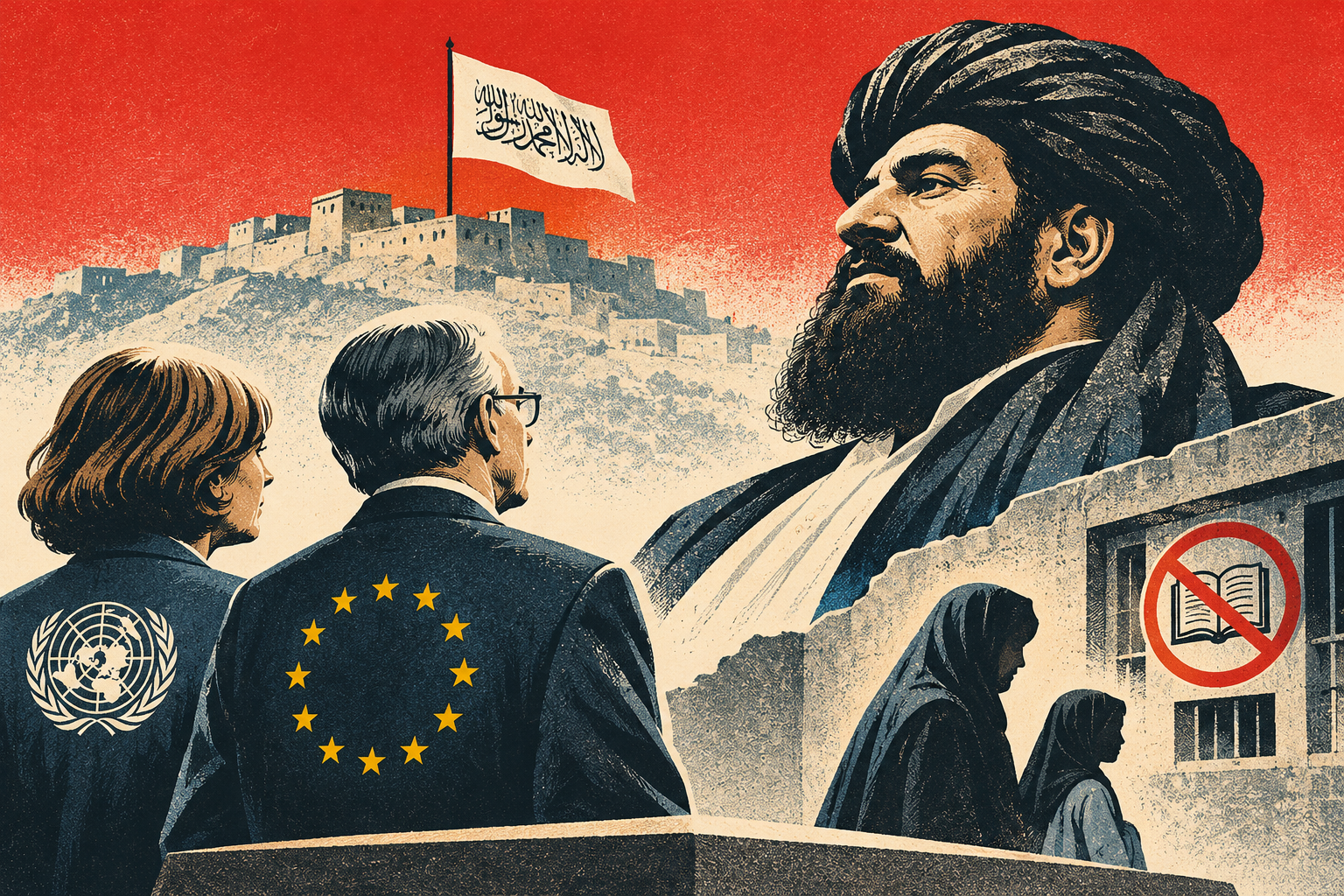
Illustration: The Convention / AI-generated editorial artwork