Market Power Without Leverage? The EU’s China Test
Europe’s hybrid-car bargain with Beijing bought time but not balance. The EU’s future as a geoeconomic actor now depends on two tasks. It must turn its single market into a credible bargaining tool. It must also shrink the chokepoints China holds over it.
On 9 October 2026, EU Trade Commissioner Maroš Šefčovič left Beijing with three “shared understandings.” The first would curb Chinese hybrid-car exports to Europe. The second would cut Chinese tariffs on some European goods. The third promised a “green channel” for rare-earth licences. A week later EU leaders asked the Commission to “urgently enhance the EU toolbox with new instruments” against global macroeconomic imbalances. EUobserver described the phrase as a euphemism that avoided naming China. Then on 29 October Volkswagen reported a €5.8 billion third-quarter loss as Chinese competition intensified. For years the carmaker symbolised Europe’s profitable bet on China. Today Chinese rivals are squeezing it at home and abroad.
Taken together, these moments show that Europe’s China policy has already hardened. The more difficult question concerns the Union’s future. Can a polity built to exert power through the size and rules of its market learn to bargain like a geoeconomic actor? Its counterpart has spent a decade turning industrial dominance into strategic leverage.
The EU’s view of China has shifted in stages. In its 2019 Strategic Outlook, the Commission described China at once as a partner, a competitor and a systemic rival. That triple formula allowed Brussels to keep trading while voicing concern. The balance began to tilt in 2021. After Beijing sanctioned European lawmakers, the European Parliament froze any consideration of the Comprehensive Agreement on Investment. In March 2023, Ursula von der Leyen called for “de-risking” rather than decoupling. The Union adopted its first Economic Security Strategy three months later.
Trade defence followed. In 2024, the EU imposed anti-subsidy duties of up to 35.3% on Chinese battery-electric vehicles. Beijing opened its own investigations into European pork and dairy. In 2025, China introduced two waves of rare-earth export controls in April and October. The second wave was later suspended. By 2025, the bilateral goods deficit had reached about €360 billion. In June 2026, the two sides launched new Trade and Investment Consultations and set an October deadline for tangible results. That deadline frames the events analysed below.
This article argues that October 2026 exposed a structural asymmetry. Beijing bargains with chokepoints it controls alone and can open or close at will. Brussels bargains with market access. Withholding that asset requires 27 governments to agree.
The article makes three further claims that receive little attention in current debates. The hybrid quota may enrich the very firms it targets. China’s licensing system gives Beijing information as well as leverage. And Europe’s product-by-product tools cannot offset a price advantage that is partly macroeconomic. Unless the EU addresses all three, its new toolbox may win short-term relief in one sector and lose long-term leverage.
Analysis
What Beijing Gave and What It Bought
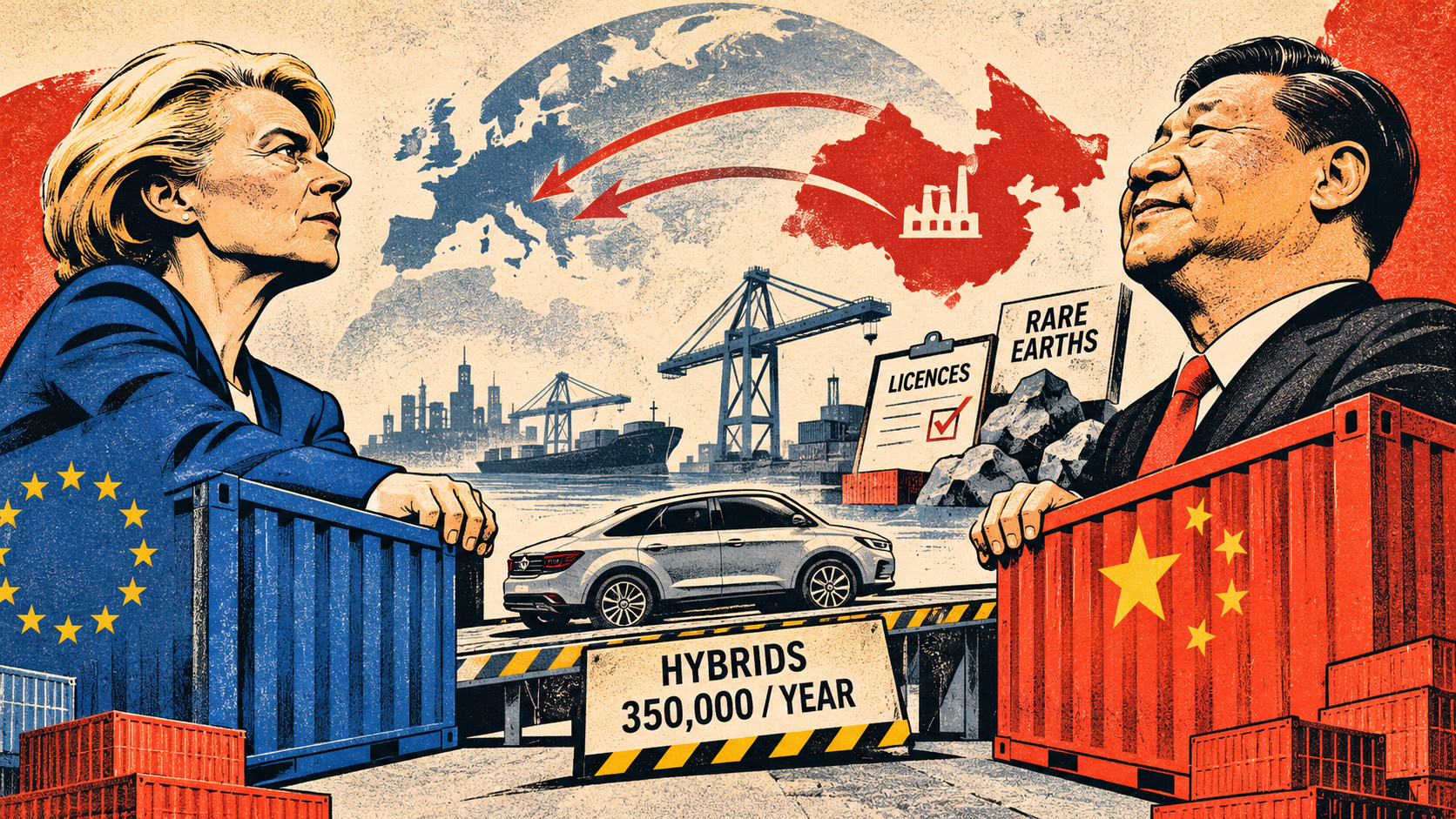
The headline concession looks large. The EU will apply country-specific quotas admitting 350,000 Chinese hybrids a year for four years, with a fixed annual adjustment of 6%. Chinese hybrid imports had been projected to reach about 800,000 units in 2026. Brussels therefore presented the deal as halving the flow.
Beijing told a different story. Its commerce ministry said the arrangement would still allow growth from 2025 levels. It also insisted that Chinese exporters must not be treated less favourably than others. The baseline and the enforcement details remain undisclosed. Scale matters more than framing. Hybrids made up only 2.06% of Chinese exports to the EU between January and August 2026. The monthly deficit reached a record US$34.8 billion in September. Chinese customs data showed exports to the EU up 25% over the past year.
The second understanding is smaller still. Chinese tariff cuts on goods such as car parts, olive oil and footwear cover almost €4 billion of European exports. They save exporters roughly €225 million in duties. As Alicia García-Herrero of Bruegel notes, most of the imbalance lies in machinery, chemicals, metals, batteries, solar panels and ICT. The deal touches none of them.
China’s gains are less visible but likely more durable. According to Beijing’s own readout, the EU agreed to a technical dialogue on its Foreign Subsidies Regulation. Brussels and the member states also promised to help resolve “key licensing cases” in the dual-use sector. García-Herrero suggests that this could open Dutch controls on advanced lithography to bargaining. Beijing also reopened the EU’s exclusion of Chinese solar inverters from EU-funded projects.
In short, China traded relief in one narrow sector for influence over the very tools Europe built to defend itself. The timing hinted at a further aim. The deal came one week before the European Council of 15 and 16 October. It gave leaders a reason to believe that dialogue was working and that escalation could wait.
An Old Lesson the Quota Ignores
The hybrid deal also repeats a mistake that trade history has already documented. In 1981, Japan agreed to restrain its car exports to the United States. A 1985 hearing of the US Congress Joint Economic Committee heard testimony on what followed. Japanese carmakers could not sell more cars. So they sold more expensive ones. They shifted exports toward larger and better-equipped models and earned what officials called economic rents on each vehicle.
Consumers paid the bill. The US International Trade Commission estimated the added cost to American buyers at about US$15.7 billion over four years, according to the same testimony. Later econometric work by Berry, Levinsohn and Pakes evaluated the policy against consumer welfare, firm profits and the tariff revenue Washington gave up by choosing a quantity limit instead of a duty.
The parallel with October 2026 is close. A volume cap on Chinese hybrids leaves prices free. Chinese brands can respond by moving upmarket and raising margins on each permitted car. The scarcity premium then flows to the exporters rather than to European treasuries. The quota may also accelerate local assembly, just as Japanese “transplant” factories followed the 1981 restraint. Europe could end up with fewer imports on paper but stronger Chinese competitors in practice. This lesson matters because few commentators have raised it. The debate has focused on how many cars cross the border. It should also ask who captures the value of the cars that do.
Two Currencies of Power
An old insight from international political economy clarifies the deeper asymmetry. Albert Hirschman showed in 1945 that trade creates power when dependence is unequal. The state that can more easily do without the exchange gains influence over the one that cannot. Henry Farrell and Abraham Newman later refined this idea as “weaponized interdependence.” States that control central nodes in global networks can exploit a chokepoint effect. They can deny access to others at little cost to themselves.
China’s rare-earth licensing regime fits this model closely. It is centralised and discretionary. It can also be aimed at single firms. On 24 July 2026, Beijing added 14 European entities to its export-control list, Rheinmetall among them. MERICS links the move to EU sanctions imposed a day earlier on 14 Chinese companies over their alleged support for Russia’s war. One ministry made one decision against named companies. It needed no one’s consent.
The EU’s main currency works differently. Chad Damro describes the Union as “Market Power Europe.” It projects influence through the size of its internal market and the rules that govern it. Yet market access is a diffuse asset. Restricting it hurts European importers, consumers, and particular national economies. Every use therefore needs a political coalition. Sophie Meunier and Kalypso Nicolaïdis identified this problem two decades ago. They called the EU a “conflicted trade power.” In later work, they showed how trade policy became geopolitical while the Union’s decision rules lagged behind.
Robert Putnam’s two-level game explains why this matters at the bargaining table. Beijing negotiates formally with the Commission. At the same time, it works on the domestic politics of individual capitals. The 2026 record shows how. China and Germany restarted their bilateral economic commission on the eve of the EU-level talks in June. Spain courted Chinese battery and car investment. Hungary’s incoming government signalled continued openness. Leverage that depends on 27 sets of interests is leverage the other side can price and divide.
None of this means Europe lacks power. García-Herrero and Tim Rühlig argue in a March 2026 Chaillot Paper that weak household demand makes Chinese growth ever more reliant on exports. That turns the single market into a lifeline for Beijing. China’s growth of 4.5% in the third quarter was powered largely by exports.
Europe also holds chokepoints of its own, though it rarely thinks of them that way. MERICS notes that China still depends on German machine tools, French metrology instruments and Dutch lithography machines. This is why Beijing would likely spare such goods in any retaliation. The problem is therefore not a lack of leverage. The problem is converting it. Europe holds a strong hand that its institutions make slow and costly to play.
The Franco-German Turn
For this reason the decisive event of October was a letter and not the Beijing deal. On 5 October Chancellor Friedrich Merz and President Emmanuel Macron wrote to von der Leyen. They said the existing trade-defence toolbox was no longer fit for purpose. They proposed an instrument loosely modelled on Section 301 of the US Trade Act. It could restrict or cut off access to the single market in response to severe and systematic distortions. They also asked for a diversification tool and for investigations by sector instead of by product.
For Berlin, this marks a reversal. In October 2024 Germany voted against EU duties on Chinese electric vehicles, partly to avoid retaliation against its carmakers. Two years later its deficit with China had reached €89.3 billion for 2025. German industry itself was now lobbying for tougher action.
Other institutions moved in the same direction. On 7 October the European Parliament adopted a recommendation on EU-China relations by 454 votes to 86 with 110 abstentions. It urged the use of the Anti-Coercion Instrument if Beijing weaponises critical dependencies. At the summit, leaders broadly endorsed the Franco-German paper. Von der Leyen listed three tools in preparation. These were a DiversifyEU initiative, a Solidarity Mechanism against coercion and a new instrument to limit access to the single market.
The real novelty is not the instrument but its decision rule. The European Policy Centre reads the Franco-German non-paper as proposing that restrictions go ahead unless a qualified majority of member states blocks the Commission. This reverse logic matters. Thomas Schelling argued that credible threats often depend on reducing one’s own freedom to back down. A rule that makes restriction the default shifts the burden of building coalitions. Those who prefer inaction must now organise. Market power would stop being a collective good that Beijing can splinter. It would become a commitment that Beijing must take seriously.
Rare Earths and Borrowed Autonomy
Even a credible market-access tool would leave one exposure untouched. In October 2025, China announced a wider package of export controls that also reaches foreign-made products containing Chinese rare earths. Beijing suspended the package only until 10 November 2026. In late September, China’s commerce ministry said its trade arrangements with the United States had been extended to 10 January 2027. The statement did not explicitly mention rare earths.
This is an uncomfortable fact for a Union that speaks of strategic autonomy. Europe’s near-term supply security is in effect a by-product of a deal between Washington and Beijing. Its renewal follows their timetable and not Europe’s. Georg Riekeles and Ian Hernandez of the European Policy Centre warn that Europe cannot remain the adjustment variable in bargains struck elsewhere.
The October green channel changes little. MERICS observes that Brussels treated its own dual-use controls as equivalent to China’s regime. Yet the two systems serve different ends. The EU’s controls exist to prevent military misuse. China’s regime is used for geopolitical leverage. Beijing meanwhile keeps its hand on the switch.
A further cost of licensing is rarely discussed. Export-control systems usually ask applicants to describe end users and end uses. Each application from a European firm can therefore tell Chinese authorities who buys which material, in what volume and for what product. A faster green channel may mean more applications and more insight into European supply chains, including in defence. Licensing is thus a source of information as well as leverage. Europe should treat that information flow as a security question in its own right.
Diversification will take years. Luisa Santos of BusinessEurope told Euronews that diversification is not an option for some critical raw materials such as rare earths unless new sources emerge. MERICS also identifies rare earths as Beijing’s ideal retaliatory lever. They would hit Europe hard at almost no cost to Chinese exports. Here lies the heart of the asymmetry. Each step Brussels takes on market access can be answered by a cheaper step on supply.
The Variables Europe Overlooks
Two further variables shape the contest but rarely enter the trade debate. The first is the exchange rate. The European Policy Centre cites estimates that the renminbi is undervalued by 20 to 30%. Using producer prices adjusted for exchange rates, it finds that the euro area’s relative cost position against China worsened by more than 40% between January 2020 and January 2026.
This matters for the choice of instruments. Anti-dumping and anti-subsidy cases work product by product. A currency-wide price advantage touches every product at once. No number of individual cases can fully offset it. This is why Paris and Berlin proposed a dialogue with Beijing on exchange rates and financial market access as part of their joint roadmap. A trade strategy that ignores the currency treats the symptom and not the cause.
The second variable is time. The EPC warns that Beijing can read Europe’s political calendar. Germany is under economic strain and France faces a presidential election in 2027. A four-year quota and a consultation process with meetings scheduled into 2027 suit a patient negotiator. Each delay lets Chinese firms deepen market share and localise production before any European instrument takes effect.
The Case for Restraint
A serious case for caution deserves a hearing. The first argument concerns cost. Chinese firms supply about 70% of the solar inverters installed across the EU. Much of Europe’s energy transition runs on Chinese inputs. Business groups warn that forced diversification will raise costs for firms that already compete on thin margins.
The second argument concerns retaliation. MERICS expects Beijing to target high-volume European exports that China can easily do without. Agri-food, cosmetics, fashion and luxury cars top that list. China also opened a new anti-dumping probe into an EU chemical product days before the Beijing talks.
The third argument concerns legitimacy. Beijing frames each European measure as protectionism that breaches WTO rules. That charge resonates in parts of the Global South. Europe can reduce this risk through design. In June, EU leaders asked the Commission for country-neutral instruments. Instruments that apply to any partner, rely on published data and expire unless renewed are far easier to defend in Geneva than measures aimed at one country.
The fourth argument is subtler. The hybrid quota exempts vehicles built inside the EU. This strengthens the incentive for Chinese carmakers to produce in Europe. Chinese investment in Europe, including the United Kingdom, already reached a seven-year high of €16.8 billion in 2025 according to Rhodium Group and MERICS. Some would argue that localisation offers a more natural path to rebalancing than confrontation.
These objections call for calibration rather than abstention. The cost of inaction is already visible in Volkswagen’s losses and in Europe’s worsening cost position. Localisation without conditions also carries risks. Without rules on local content, technology and data it simply moves dependence inside the single market. That is why Spain itself has called for EU-wide rules on strategic Chinese investment.
A final dimension is often missing from European debates. Chinese exports to ASEAN rose 52% year on year in September 2026, twice the pace of shipments to the EU. If Europe raises its walls alone, part of the surplus will flow toward Southeast Asia. Some of it may then return to Europe through transshipment. That would strain the very partners Brussels needs for diversification and weaken the measures themselves.
Conclusion and Recommendations
The hybrid-car understanding will likely be remembered less for its effect on car imports than for what it revealed about European power. It showed a Union finally willing to name the problem. It also showed a Chinese government confident enough to concede at the margins while keeping its most valuable lever in reserve.
The analysis points to one central conclusion. Europe’s weakness is not a lack of leverage but the slow and costly process of using it. The remedy lies less in new legal texts than in changing how existing strengths can be deployed. Five priorities follow.
First, the EU should build automaticity into the market-access instrument. Reverse qualified majority voting should come with published triggers based on data. Sustained import surges, price undercutting and evidence of systemic subsidies are obvious candidates. A currency-adjusted measure of price gaps should be among them. Beijing can observe such triggers. It cannot negotiate them away through side deals like the hybrid understanding.
Second, Europe should capture the value that quotas create. Where volume limits are unavoidable, they should become tariff-rate quotas. Imports within the limit would face a duty and imports above it a higher one. Alternatively, import licences could be auctioned. Either way, the scarcity premium would flow to European budgets rather than to exporters. Those revenues could then finance the Solidarity Mechanism.
Third, the Union should fund solidarity before it is tested. Retaliation will fall unevenly on French cognac, Spanish pork or Dutch technology firms. A financed Solidarity Mechanism would compensate the sectors and member states that are hit. It would remove Beijing’s easiest wedge, which is making one capital pay for a collective decision.
Fourth, Brussels should treat critical minerals and licensing as security policy rather than trade policy. Joint purchasing through the EU’s raw materials platform should accelerate. So should strategic stockpiles and long-term supply deals with partners such as Australia, Japan and the Philippines. The EU should also keep a confidential register of its own chokepoints, from machine tools to lithography. Such a register would show where Europe can credibly respond. Any further easing of its dual-use controls should depend on measurable Chinese licensing performance such as approval rates and waiting times. Finally, European firms should receive guidance on limiting the sensitive data they disclose in Chinese licence applications.
Fifth, Europe should coordinate with Asia and not only act against China. Japan, South Korea and ASEAN face the same surplus pressure. Shared monitoring of trade diversion, stricter rules of origin against transshipment and coordinated safeguards would keep Europe’s defence from becoming Southeast Asia’s burden. Joint investment would also give diversification real destinations.
The coming months will test which lesson Europe draws. The Commission is expected to present its supplier-diversification instrument in early December. It may arrive alongside the market-access tool and new measures on Chinese chemicals and machinery. A ministerial video conference with Beijing is planned for January. The third round of consultations follows in March 2027. Meanwhile the US-China truce that has kept China’s wider rare-earth controls on hold is set to run until 10 January 2027.
If Brussels uses this window well, October 2026 may mark the moment a market power learned to bargain. That means automatic instruments, captured quota rents, funded solidarity and less exposed supply chains. If it instead treats the October understandings as proof that dialogue alone works, Beijing will have bought exactly what it wanted. It will have gained time. It will also face a Europe that negotiates with one hand while China keeps the other on the switch.
(The opinion expressed in this article belong only to the author and do not necessarily reflect the views of The Convention).
Illustration: The Convention / AI-generated editorial artwork