A Generation Shut Out: What Gen Z Wants from Europe and India?
A young person can try to study hard and obtain a degree, go looking for work and obey the rules and still have no prospects in the future.
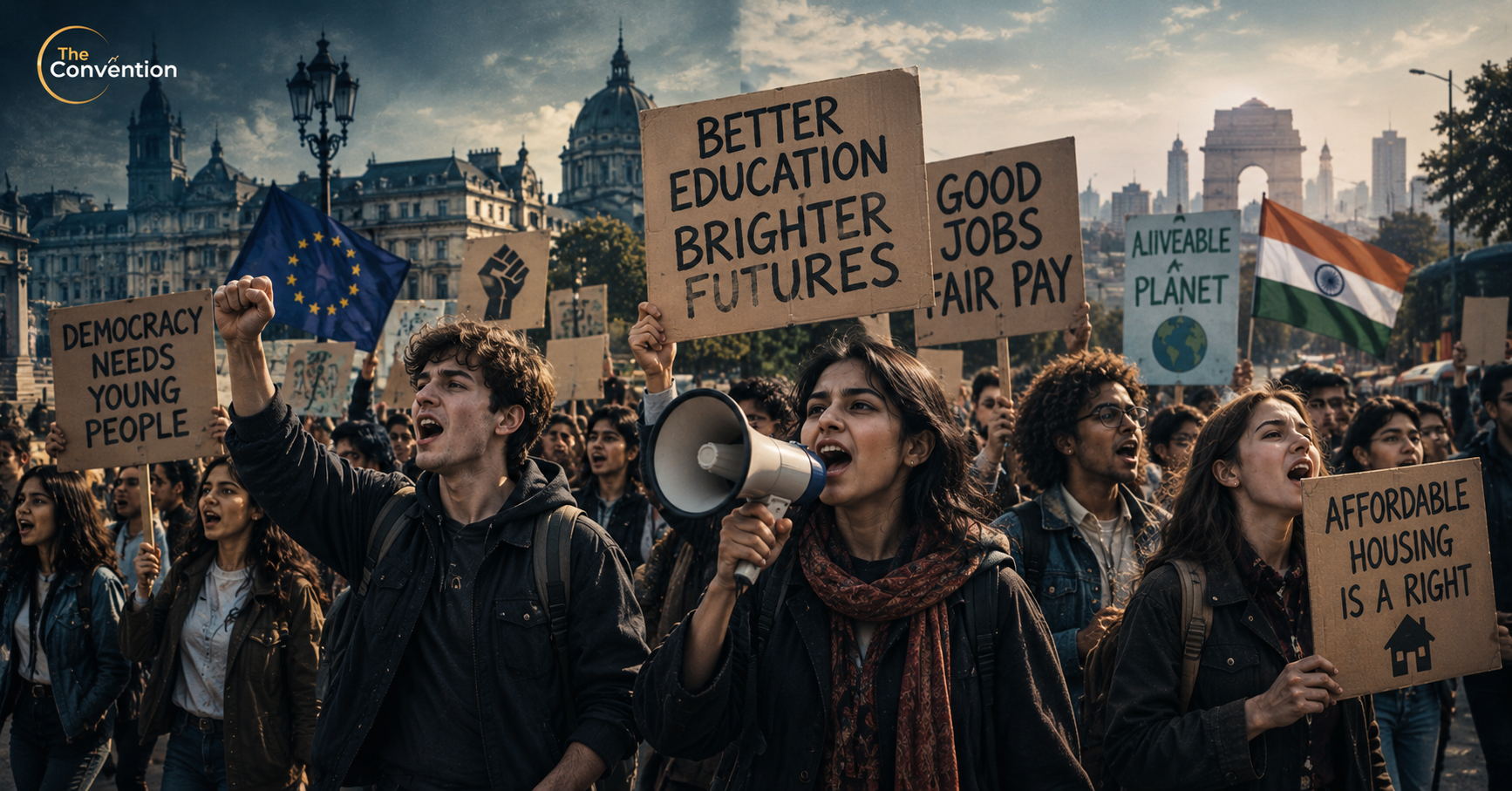
This frustration has been emerging in anti-government protests all over Europe and in India. These demonstrations are not all a single movement and Gen Z is not a single political voice. But many of the protests share a common concern: the gap between youth expectations and institutional outcomes.
Requests are very specific. Youth are seeking reliable education, Affordable housing, Meaningful employment, Accountable government, Civil liberties, and a credible opportunity to build an independent life. They are not just asking to be listened to. They are wondering if there is still a future to believe in for them in their political systems.
Different countries, familiar frustrations
In October 2026, demonstrations across France, Spain, Portugal, Italy and Albania have brought education, housing, living costs, corruption and employment back to the centre of political debate.
In France, high-school students have protested overcrowded classrooms, teacher shortages, deteriorating school facilities and an opaque university-admissions system. Some protests have also broadened into wider demonstrations over rising living costs and fuel prices. In Spain, housing affordability has become a central concern, with protesters demanding lower rents, stronger protections against eviction and restrictions on large investment funds purchasing residential property. Portugal has faced similar housing pressures, while demonstrations in Italy have focused on household costs. In Albania, protesters have raised concerns about corruption, limited employment opportunities and education standards. The Guardian’s overview of the European protests describes these as distinct national movements with different immediate triggers.
The common thread is not a single ideology. It is a generational experience of insecurity. Young people are entering adulthood in societies where education may be expensive or unreliable, employment may be precarious and housing may be unaffordable. Political leaders continue to speak about growth and opportunity, but many young people are asking a more personal question: Where, precisely, is my place in the future being promised?
India presents a different political and economic context, but some of the same questions are visible. Youth-led demonstrations over examination irregularities, educational accountability and employment pressures have expanded into broader concerns about democratic institutions and electoral credibility. The protests have included student organisations, opposition parties, civil-society groups and the Gen Z Cockroach Janta Party. Human Rights Watch has reported allegations of arbitrary detention, excessive force, restrictions on movement and the detention of journalists covering the demonstrations. Its October 2026 report calls for the protection of peaceful protest and the release of those wrongfully detained.
These developments should not be presented as evidence of one global Gen Z uprising. Europe and India differ in their political systems, economic structures and protest traditions. Their movements have different demands, organisers and relationships with political parties. Yet a comparison remains useful because it reveals a broader crisis of confidence: young citizens are increasingly unwilling to accept institutions that ask for patience while offering no convincing account of when their lives will improve.
From opportunity to insecurity
For much of the post-war period, education was presented as a route to stability. The promise was familiar: study, qualify, find work and build an independent life.
That promise has not disappeared, but it has become less reliable.
In Europe, rising rents and household costs can delay independence even for people with university degrees and full-time employment. In India, competition for educational opportunities is intense, while the supply of secure and well-paid work does not always match the aspirations created by expanded access to higher education. A degree remains important, but it no longer guarantees economic security.
The resulting frustration is not simply about income. It is about dignity, fairness and the relationship between effort and reward. Young people are being told to invest in themselves while confronting systems that often fail to provide dependable pathways into work, housing and civic participation.
This is why protests about schools can become protests about housing, and why demonstrations over examinations can evolve into wider demands for political accountability. Education is not experienced as an isolated sector. It is connected to employment, social mobility, family expectations and the possibility of living with security.
When that connection breaks down, disappointment becomes political.
Democracy must deliver, not merely promise
Economic insecurity is only part of the problem. The other part is institutional trust.
When students encounter examination irregularities, when citizens question electoral procedures or when peaceful protesters face disproportionate force, the issue is no longer only whether a policy has failed. It is whether institutions are capable of correcting themselves.
Protest is not proof that democracy has failed. In many cases, it is evidence that people still believe public pressure can produce a response. But that belief weakens when demonstrations lead only to temporary announcements, resignations without structural reform or investigations without credible accountability.
Governments should therefore resist the temptation to treat youth mobilisation primarily as a security problem. Violence, intimidation and destruction should be addressed through lawful and proportionate measures. Peaceful protest, however, is a democratic right—not a threat to be managed simply because it is inconvenient.
Young people do not lose their political rights because they are angry. Their anger may be one of the clearest signals that institutions are failing to respond to the realities of their lives.
What Gen Z is asking for
The demands emerging from these protests point towards practical responsibilities.
First, governments must make education reliable and accessible. That requires adequate staffing, transparent examinations, fair admissions and institutions capable of correcting errors openly.
Second, governments must widen access to decent work. Economic growth is not enough if it produces few secure jobs or leaves graduates competing for limited opportunities. Young people need productive investment, skills development and credible routes from education into employment.
Third, housing and the cost of living require serious policy attention. Young people cannot be told to become more resilient while the basic costs of independence continue to rise beyond their reach.
Finally, democratic institutions must become more accountable. That means independent oversight, freedom of expression, protection for peaceful protest and meaningful opportunities for young people to participate in decisions that affect them.
Consultation exercises and carefully managed social-media campaigns are not substitutes for political influence. Young people need evidence that their concerns can change policy—and that officials face consequences when institutions fail.
From protest to participation
Protest can expose a problem, but it cannot by itself build a durable alternative. Movements may fragment, be absorbed by established political actors or struggle to convert anger into workable proposals.
That is not an argument against protest. It is an argument for creating political systems in which protest can develop into sustained civic participation.
Young people need more than the right to march. They need access to parties, unions, local government, civil-society organisations and public institutions where they can help shape policy. They need political spaces in which disagreement is not treated as disloyalty and participation is not reduced to voting every few years.
The challenge is shared by both governments and movements. Governments must listen before frustration hardens into permanent distrust. Movements must develop the organisation, coalitions and policy proposals required to hold institutions accountable beyond the moment of mobilisation.
A test of political leadership
Gen Z is not asking every government for the same programme. Nor should its protests be romanticised. Young movements can be divided, politically exploited or uncertain about how to turn public anger into lasting reform.
But these complications do not make the grievances less important. They make serious political engagement more necessary.
The central question for leaders in Europe and India is whether they see young people as citizens whose futures deserve investment—or as a restless demographic to be managed until the streets grow quiet.
A generation that feels excluded from opportunity will not be reassured by slogans about national growth or democratic greatness. It will judge institutions by whether education is fair, work is attainable, housing is affordable, rights are protected and political power can be held accountable.
The lesson is not that Gen Z will inevitably transform politics. It is that governments cannot indefinitely separate political legitimacy from the material conditions of people’s lives.
When promises of progress cease to feel credible, the street becomes the place where that contradiction is made visible.
The future Gen Z wants is not simply a seat at the table. It is a fair chance to build a life—and a political system willing to answer when that chance is denied.
Editorial source notes
The article is grounded in reporting and analysis from The Guardian, Human Rights Watch, Reuters and the London School of Economics.
Editorial note: The comparison in this article does not suggest that European and Indian protests form one coordinated movement. It treats them as separate political developments that nevertheless illuminate shared questions about economic security, representation, accountability and trust. Because these events are unfolding, all dates, claims about arrests, government responses and protest demands should be rechecked immediately before publication.