Israel’s Coalition Test: Can Eisenkot Form a Government?
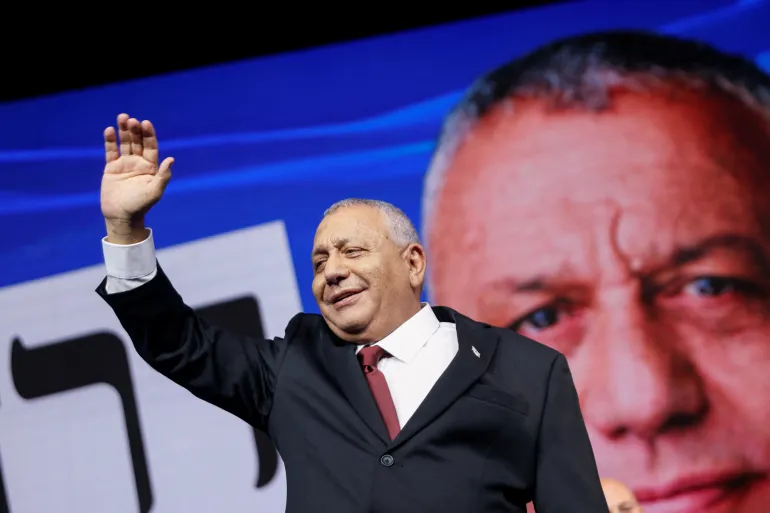
Israel has entered a critical phase of political uncertainty following President Isaac Herzog’s decision to give former military chief Gadi Eisenkot the first opportunity to form a government after the inconclusive parliamentary elections of October 27.
Herzog announced his decision on November 7, and Eisenkot formally received the mandate the following day. The leader of the centrist Yashar party now has 28 days, with a possible 14-day extension, to assemble a governing coalition. However, the electoral arithmetic suggests that replacing Prime Minister Benjamin Netanyahu may prove considerably more difficult than securing the presidential mandate.
According to Reuters, neither Eisenkot nor Netanyahu emerged from the election with a clear parliamentary majority, leaving Israel facing another potentially prolonged period of coalition negotiations.
The Parliamentary Arithmetic
Israel’s 120-member Knesset requires a majority of 61 seats for a conventional majority government. Netanyahu’s right-wing and religious alliance secured 53 seats, while Eisenkot’s four-party opposition bloc obtained 48. Arab-led parties collectively won 19 seats, making them potentially decisive in determining the next government’s composition.
Eisenkot’s Yashar party won 21 seats, establishing him as Netanyahu’s principal challenger. His candidacy subsequently received recommendations from 67 lawmakers, including representatives of Arab-led parties, compared with 46 recommendations for Netanyahu.
Yet these endorsements do not automatically translate into a governing coalition.
As The Washington Post reported on November 7, Eisenkot faces significant resistance within his own political alliance to cooperation with Arab-led parties, despite their willingness to support his nomination.
The distinction between receiving parliamentary recommendations and commanding a functioning government is central to understanding Israel’s present political deadlock.
Three Possible Paths to Government
Eisenkot has three principal options, each involving substantial political compromises.
The first involves parliamentary support from Arab-led parties. Together, Eisenkot’s 48-seat bloc and the 19 Arab-led lawmakers would command 67 seats. However, Eisenkot has ruled out bringing Arab-led parties into his government, while some of his political partners oppose relying on their support.
A minority government sustained by outside parliamentary support remains a theoretical possibility, but its durability would depend on agreements among parties with sharply different political priorities.
The second option involves ultra-Orthodox parties, particularly Shas and United Torah Judaism, which have traditionally aligned with Netanyahu.
Their participation could provide Eisenkot with the numbers needed for a majority. Nevertheless, disagreements over compulsory military service represent a major obstacle. Eisenkot and several opposition allies support broader conscription obligations, while ultra-Orthodox parties have historically defended exemptions for religious students.
According to Reuters’ November 8 analysis, these competing demands complicate the possibility of a new coalition.
The third possibility is a national unity government involving Netanyahu’s Likud party. Such an arrangement could potentially overcome the parliamentary deadlock, but disagreements over political leadership, responsibility for recent conflicts and the distribution of power make negotiations difficult.
Eisenkot has expressed support for a broad national emergency government, although this does not necessarily indicate a willingness to serve under Netanyahu.
Why the Coalition Matters Beyond Israel
The consequences of these negotiations extend beyond domestic politics.
Israel’s next government will inherit major security and diplomatic challenges involving Gaza, Iran, regional relations and its strategic partnership with the United States.
Eisenkot’s military background could shape his approach to national security, but his previous position as Israel’s military chief does not establish what policies a future coalition would adopt.
Any government would also face competing domestic expectations concerning security, political accountability and the relationship between religious and secular communities.
The composition of the coalition could therefore prove as consequential as the identity of the next prime minister.
A government dependent on ultra-Orthodox parties might face difficult negotiations over military service legislation. A minority administration supported by Arab-led lawmakers could encounter resistance over security policy and Palestinian political rights. A unity government involving Likud could offer parliamentary stability while limiting the scope of political change.
These are potential consequences rather than predetermined outcomes.
Netanyahu’s Political Future
Although Netanyahu’s alliance lost its parliamentary majority, he remains a significant force in Israeli politics.
Likud emerged as the largest individual party, securing 27 seats. Netanyahu could receive an opportunity to form a government if Eisenkot’s negotiations fail.
The possibility of another election also remains if successive attempts to assemble a government prove unsuccessful.
Consequently, Herzog’s decision should not be interpreted as the conclusion of Netanyahu’s political career. It represents the beginning of a negotiation process in which parliamentary alliances, political concessions and leadership rivalries will determine the outcome.
A Test of Political Compromise
Israel’s coalition crisis illustrates a broader challenge facing fragmented parliamentary democracies: electoral results do not always produce a clear governing mandate.
Eisenkot has secured the first opportunity to form a government, but his success depends on reconciling parties divided over military service, Arab political participation and Netanyahu’s continued role in government.
The coming weeks will reveal whether these competing interests can produce a workable parliamentary arrangement or whether Israel will face another period of political uncertainty.
For now, Eisenkot has the mandate to negotiate, but not yet the majority to govern.
Image Credit: Al Jazeera