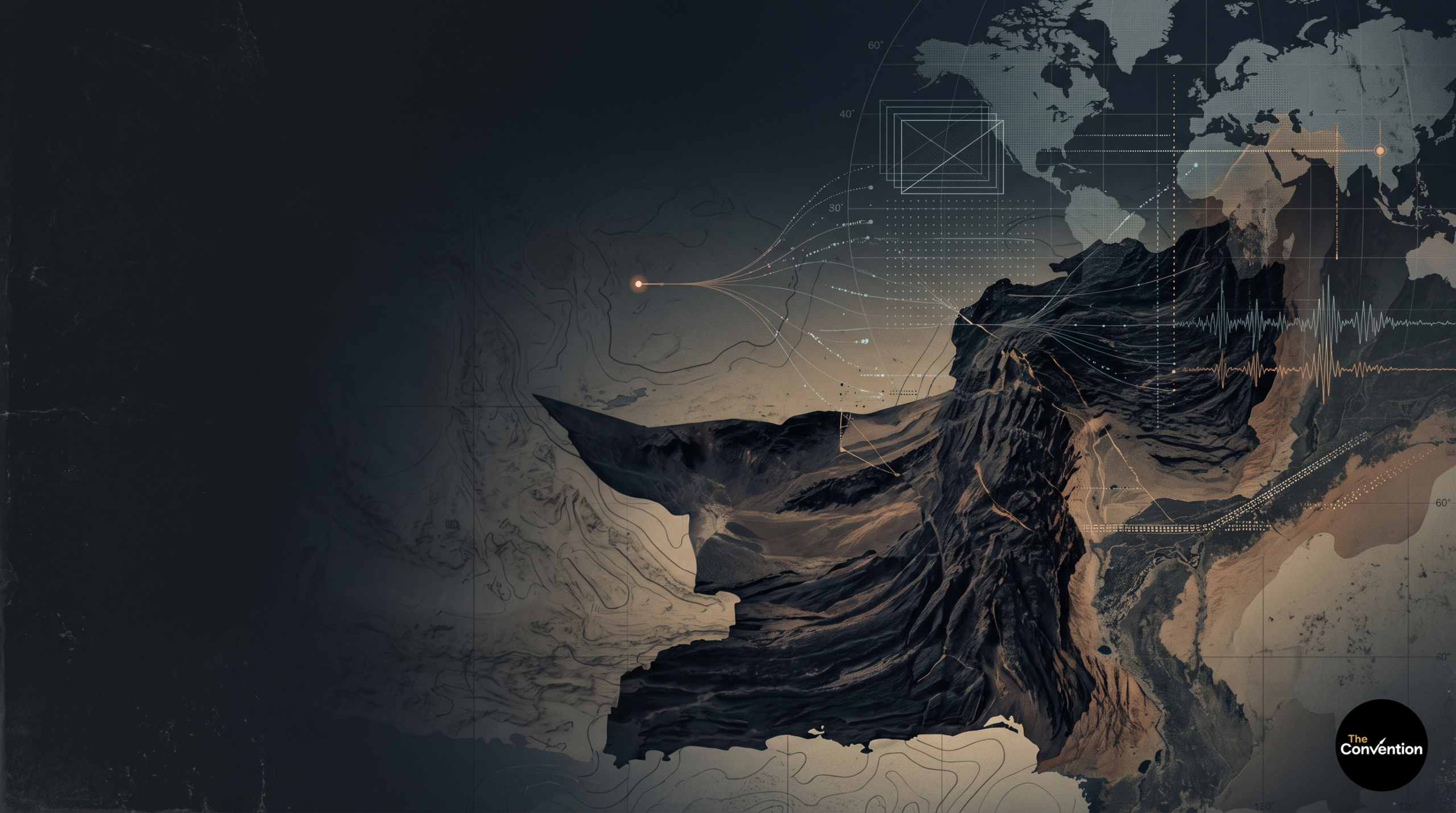
The Insurgency After the Algorithm: How AI Is Changing the Baloch Conflict
On March 11, 2025, the Baloch Liberation Army hijacked the Jaffar Express as it crossed the Bolan Pass, taking hundreds of passengers hostage in a siege that lasted two days. Pakistan’s military said it had crushed the attackers and recovered the train with limited losses. Two months later, the BLA’s media wing released its own account: a 35-minute film, shot from inside the operation, showing fighters moving through the carriages, briefing each other before the assault, and reading final messages to camera. It contradicted the army’s numbers directly, and it did so with footage rather than argument. Nobody had to believe the BLA’s press release. They could watch the operation happen.
I keep returning to that gap between what a state announces and what an insurgent group can now show. Because it says something about what is actually changing in Balochistan’s conflict and in others like it. It is not that the BLA is winning battles it once lost, or that Pakistan has lost control of Balochistan’s territory in any conventional sense. Islamabad still garrisons the province, still runs its administration, and still controls the roads on any given day. What has shifted is something adjacent to territorial control, and classical insurgency theory does not have a fully adequate name for it yet.
The old geography of insurgency
Mao’s writing on protracted war, and the counterinsurgency doctrine that grew up answering it, Galula, Robert Thompson, later Kilcullen and the population-centric COIN literature of the 2000s, all treat physical geography as close to destiny. Mountains and forests offer concealment. Borders offer an exit when pressure gets too heavy. Distance from the capital offers time to organize before the state’s writ can reach you. An insurgency’s strength, in this reading, tracks closely with the territory it can operate inside without being caught: Mao’s stages moved from strategic defense in remote base areas toward eventual conventional war, precisely because territory bought the time organization required. Stathis Kalyvas’s work on civil war violence adds a related point that control over a population, not just terrain, is what lets an armed actor extract information, recruits and compliance, and that this control is usually locally and physically bounded.
Balochistan fits this template on paper. It is Pakistan’s largest province by land area and among its most sparsely populated, with rugged, difficult terrain along the Afghan and Iranian borders that has sheltered Baloch insurgent factions through several waves of conflict since the 1970s. The physical geography is real, and it still matters, the BLA’s Majeed Brigade, designated a Foreign Terrorist Organization by the US State Department alongside the BLA itself in August 2025, still needs somewhere to train, plan and disappear to after an operation. However, the Jaffar Express video points to a second kind of geography operating alongside the first one, and it is this second geography I want to try to name.
From mountains to megabytes
Call it, algorithmic sanctuary the condition in which an insurgent movement obtains some of the political and informational advantages that physical sanctuary has historically provided, not by hiding from the state, but by outpacing it. Producing and distributing its own account of events, in its own language and its own edit, faster than the state can construct and circulate a competing one. Physical sanctuary protects fighters from capture. Algorithmic sanctuary protects a movement’s narrative from being contained or overwritten by the state’s version of events. I want to be careful about what I am claiming here. I am not arguing that a Facebook page or a Telegram channel is somehow equivalent to the Marri hills. What I am arguing is that some of the strategic functions mountains once performed, buying an actor time and distance from a more powerful adversary’s control and can now be partly reproduced in an entirely different medium, one that does not require physical distance at all.
This connects to a second idea worth naming: networked territory. A movement’s actual political geography today does not stop at Balochistan’s provincial border. It runs from the districts where fighting happens, through Baloch communities in Karachi and other Pakistani cities, out to Afghanistan and Iran, into diaspora communities in Europe, North America and the Gulf, and from there into the algorithms of platforms that decide, minute by minute, which version of a story trends. None of those nodes is territory the BLA or any Baloch political movement physically controls. However, political influence and the ability to set the terms in which an event gets understood, is increasingly distributed across exactly that network rather than confined to the province where the violence actually occurred.
Put those two ideas together and you get what I would call the geography–algorithm paradox. Digital networks appear to make physical geography less decisive for political influence, while doing nothing to reduce its importance for physical survival. An insurgent group still needs terrain, cross-border movement and local protection to keep existing as an armed organization. It no longer needs to hold that same terrain to be heard, or to shape how an event is understood beyond it. Technology has not made geography irrelevant to this conflict. It has split geography’s old functions apart, handing some to territory and others to networks, which is a very different claim than the more common one that territory simply does not matter anymore in the digital age.
Technology has not made geography irrelevant to this conflict. It has split geography’s old functions apart, handing some to territory and others to networks.“
The insurgency after the algorithm
Generative AI sits on top of this shift rather than creating it, and the distinction matters. The Jaffar Express video was not AI-generated, it was real footage, edited and released quickly by a dedicated media operation, which is itself evidence that Baloch militant messaging already runs on something closer to a production pipeline than an improvised press release. What generative tools add to that existing pipeline is speed and reach at a lower cost: multilingual captioning and voiceover produced automatically rather than by hand, image and video editing that used to require trained staff. The synthetic narration for audiences who do not read Urdu, Brahvi, Balochi or English but might watch a video with a voice in their own language. None of that requires an insurgent group to be technically sophisticated. It requires access to consumer tools that are, by 2026, freely available to anyone.
The propaganda function this serves is not really persuasion in the classical sense, but convincing a skeptical audience of a political argument. Its closer to what military theorists would call psychological operations aimed at an audience that may already be sympathetic, or at least uncertain: sustaining morale among supporters, demonstrating operational competence to potential recruits, and forcing the state onto the back foot by making its own account look slow and defensive by comparison. Sentiment analysis and narrative testing tools built for advertising let a media operation see within hours which framing of an event is spreading and which is falling flat, and adjust accordingly. This is a genuinely new capability. Historically, an insurgency’s propagandists had to guess what would resonate. Now they can measure it in something close to real time.
The state gets an algorithm too
Pakistan is not fighting this only with soldiers. Balochistan’s provincial government approved a new Safe City Authority for Quetta in February 2026, following a Chinese-financed Safe City program already running roughly 1,400 AI-linked cameras across 255 sites in the province, modeled on the same Huawei-supplied surveillance architecture deployed in Lahore and Islamabad under the China-Pakistan Economic Corridor. Facial recognition automated number-plate tracking and centralized command centers are being layered over a province where, according to Pakistani digital rights researchers, rights advocates to the tracking and disappearance of political activists have previously linked similar surveillance infrastructure. The same AI that lets Baloch militant media move faster also lets the Pakistani state watch, sort and predict at a scale that would have required an enormous manual intelligence apparatus a generation ago.
Here is the paradox I think matters more than the technology itself: better surveillance does not automatically produce better political understanding. A facial-recognition system can flag who attended a protest. It cannot tell the state why they attended, or what grievance would have to be addressed for them not to attend the next one. Surveillance intelligence, who moved where, who spoke to whom, is not political intelligence, which requires something closer to trust and legitimacy to gather honestly. A state that increasingly sees its population in granular technical detail, while its actual political relationship with that population continues to erode over land, resources, enforced disappearances and CPEC’s distribution of benefits, may be accumulating exactly the wrong kind of information advantage. It knows more about the insurgency’s movements. That is not the same as understanding why the insurgency continues to find recruits.
The battle for reality
This is where the two algorithmic capabilities, insurgent narrative production and state surveillance — start to collide with a third problem, one that has nothing to do with who is right. As synthetic media becomes normal, both the state and its opponents gain the ability of simply denying that documented events happened, or to claim that inconvenient footage was fabricated. Legal scholars Bobby Chesney and Danielle Citron named this dynamic the liar’s dividend: once fabrication becomes common enough to be plausible, genuine evidence becomes just as easy to dismiss, as fabricated evidence is to produce. In a conflict already defined by radically incompatible official narratives, the state’s casualty figures against the BLA’s, the state’s account of who initiated a given clash against local reporting that frequently contradicts it and that dividend is particularly dangerous, because it removes the assumption that documentation could, in principle, settle the dispute. Counterinsurgency in Balochistan has always involved a fight over interpretation as much as over ground. What may be new is the emerging sense that no image, on either side, can be fully trusted to end that fight on its own.
Why Balochistan matters beyond Balochistan
None of this is unique to Balochistan, and that is precisely why the case is worth taking seriously rather than treating as a regional curiosity. Insurgent and resistance movements from Myanmar to the Sahel have built comparable diaspora-facing media operations without controlling much ground at all. Ukraine’s drone-and-social-media war against Russia has shown state militaries the same lesson from the other direction and that footage released within hours can outcompete an official statement released within days. Balochistan sits at a particularly exposed junction of this trend because of what is layered on top of the conflict itself. CPEC’s investment in Gwadar and the province’s mineral wealth give China a direct commercial stake in the outcome, which is part of why Chinese-supplied surveillance technology has arrived in Quetta years before it might have otherwise, and part of why attacks on Chinese nationals working in the province carry a geopolitical weight that domestic Pakistani security incidents typically do not.
Territory, still, and something else besides
I do not think the honest conclusion here is that Balochistan’s insurgency has gone digital and left the mountains behind. The BLA still needs terrain to survive as an armed organization; the Jaffar Express operation itself required exactly the kind of physical planning, local knowledge and cross-border movement that classical insurgency theory would predict. What is changed is that the movement’s political relevance no longer depends entirely on that terrain the way it once did. A media wing releasing a 35-minute film two months after an attack is not defending territory. It is defending a version of events, distributed to an audience the operation itself never physically reached. If mountains once gave an insurgency somewhere to disappear to, the harder question now is what a state does when the thing it is actually losing ground on is not ground at all.


A very interesting piece, thank you, The Convention and Zakria, for this beautifully written piece.